
How AI Models Get Smaller—and What They Can Lose
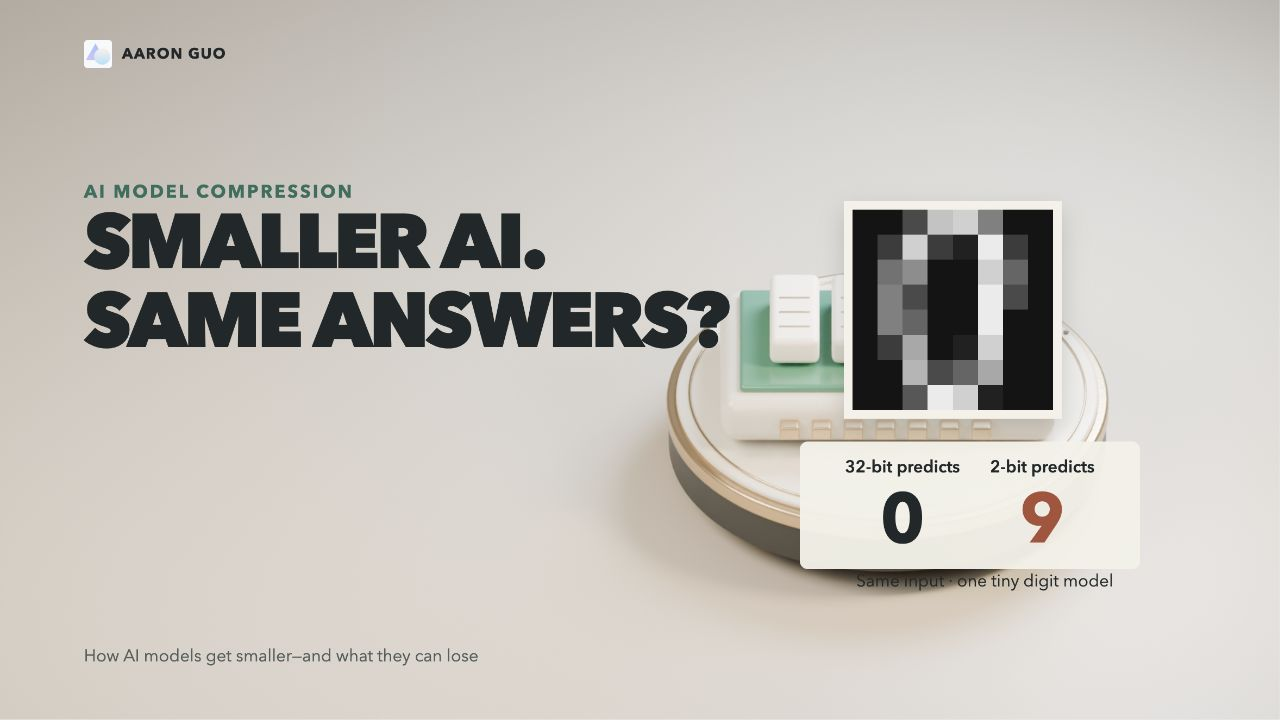
One tiny digit-reading model shrank from 2,616 bytes to 416 bytes. On the same 540 test pictures, it went from 522 correct answers to 520.
Compress it further, to 256 bytes, and the correct count falls to 390. One picture of a zero is now classified as a nine.
These are results from our small teaching experiment, using one trained classifier and a simple quantizer. They make a useful trade visible: a smaller saved model can keep much of its behavior, then lose more as precision becomes too coarse. The sensible choice depends on the answers your task needs.
How AI Models Get Smaller—and What They Can Lose
Fewer possible numbers
Imagine recording a shelf measurement as 83.7 centimeters, then rounding it to 84. That may be accurate enough for deciding where a shelf belongs. Round to the nearest ten centimeters, and 83.7 becomes 80. The error may now matter for fitting it between two walls.
Models contain learned numbers called weights. Quantization represents some of those numbers with fewer bits, using a scale to map the stored codes back to approximate values. Four bits provide sixteen possible codes; eight bits provide 256. Hugging Face's concept guide explains the schemes and practical trade-offs.
The representation changes while the original input can stay exactly the same. Whether a changed weight changes the final answer depends on the model, the method and the input.
The same 540 pictures, four saved packages
We trained a small classifier on handwritten digits from scikit-learn's digits dataset. We kept the test pictures fixed and saved the model at four weight precisions.
| Weight precision | Saved package | Correct answers out of 540 |
|---|---|---|
| 32-bit baseline | 2,616 bytes | 522 |
| 8-bit | 736 bytes | 522 |
| 4-bit | 416 bytes | 520 |
| 2-bit | 256 bytes | 390 |
The four-bit package is about 6.3 times smaller than the baseline, with two fewer correct answers. The eight-bit version has the same correct count; equal totals alone do not establish that every prediction is identical.
Package sizes include a header, biases and, where applicable, scales. Those extra bytes explain why the complete four-bit file is not exactly one-eighth of the 32-bit file.
This result does not establish that four bits are always safe or two bits always fail. It uses one small classifier, one fixed data split and one simple method. Modern methods and language models can behave differently.
A small file cannot tell you the waiting time
We unpacked each saved version into floating-point values before running the same calculation. We measured stored bytes and predictions. We did not measure runtime memory or speed.
Real low-precision execution depends on compatible software and hardware. A smaller download is useful, but it cannot tell you how quickly your own machine will finish a task. Keep storage, memory use, answer quality and waiting time as separate measurements.
Choose with your own examples
Before replacing a model, collect a small set of tasks that matter to you. Include a few easy examples, some awkward ones and cases where a wrong answer would change your decision. Write down what an acceptable result looks like.
Run the same inputs through the candidate versions. Review the changed answers and record actual task completion time on your machine, alongside storage and memory measurements where available. A smaller version may be a useful compromise; a failure on one crucial task may outweigh an attractive average.
The result to remember is concrete: 416 bytes and 520 correct answers, compared with 2,616 bytes and 522. The saving was real in this experiment, and so was the difference in answers. Choose the smallest version that still meets your requirements, using evidence from the work you actually want it to do.