
The Camera Didn't Make Everyone a Spielberg. AI Won't Either.
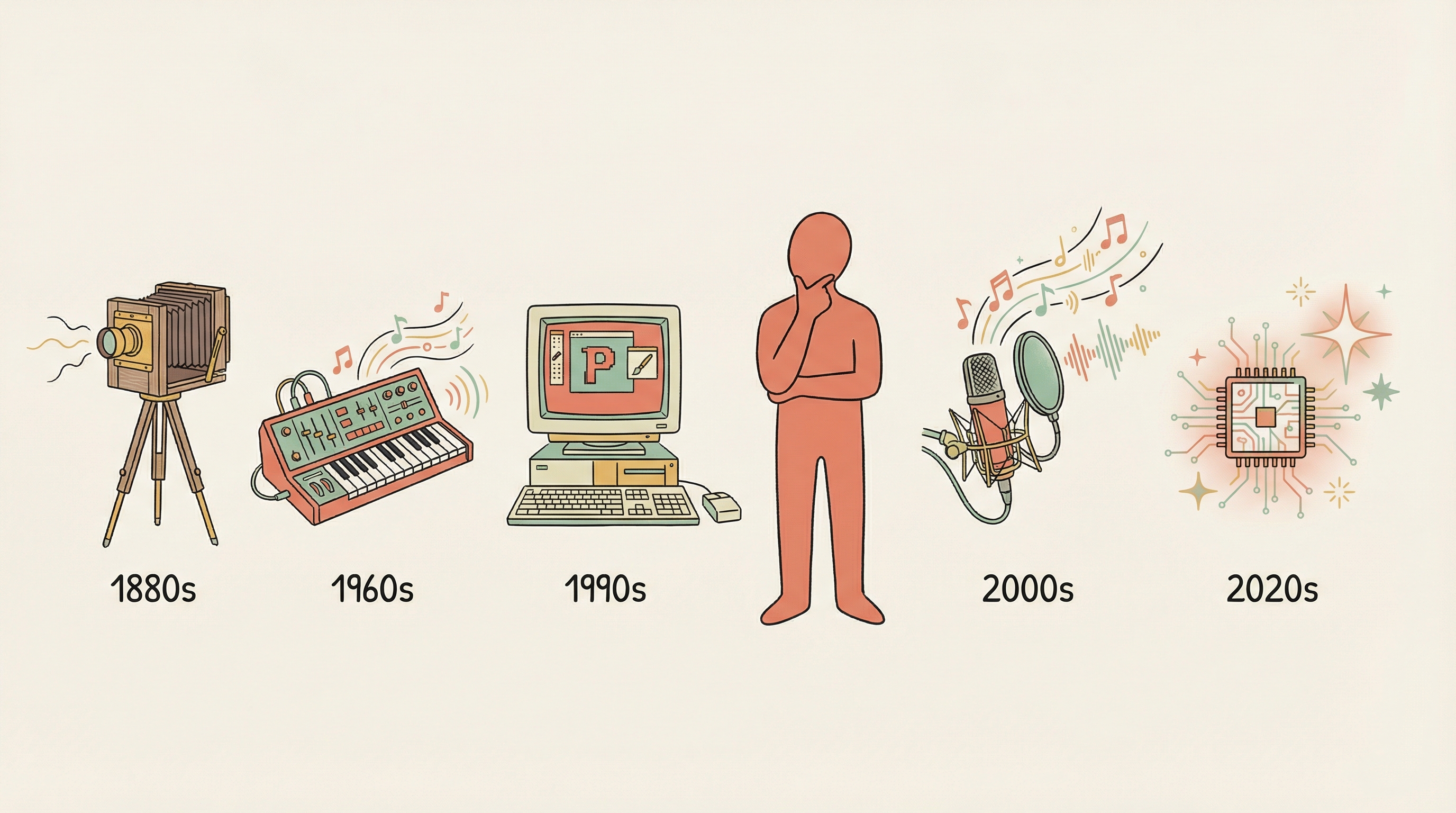
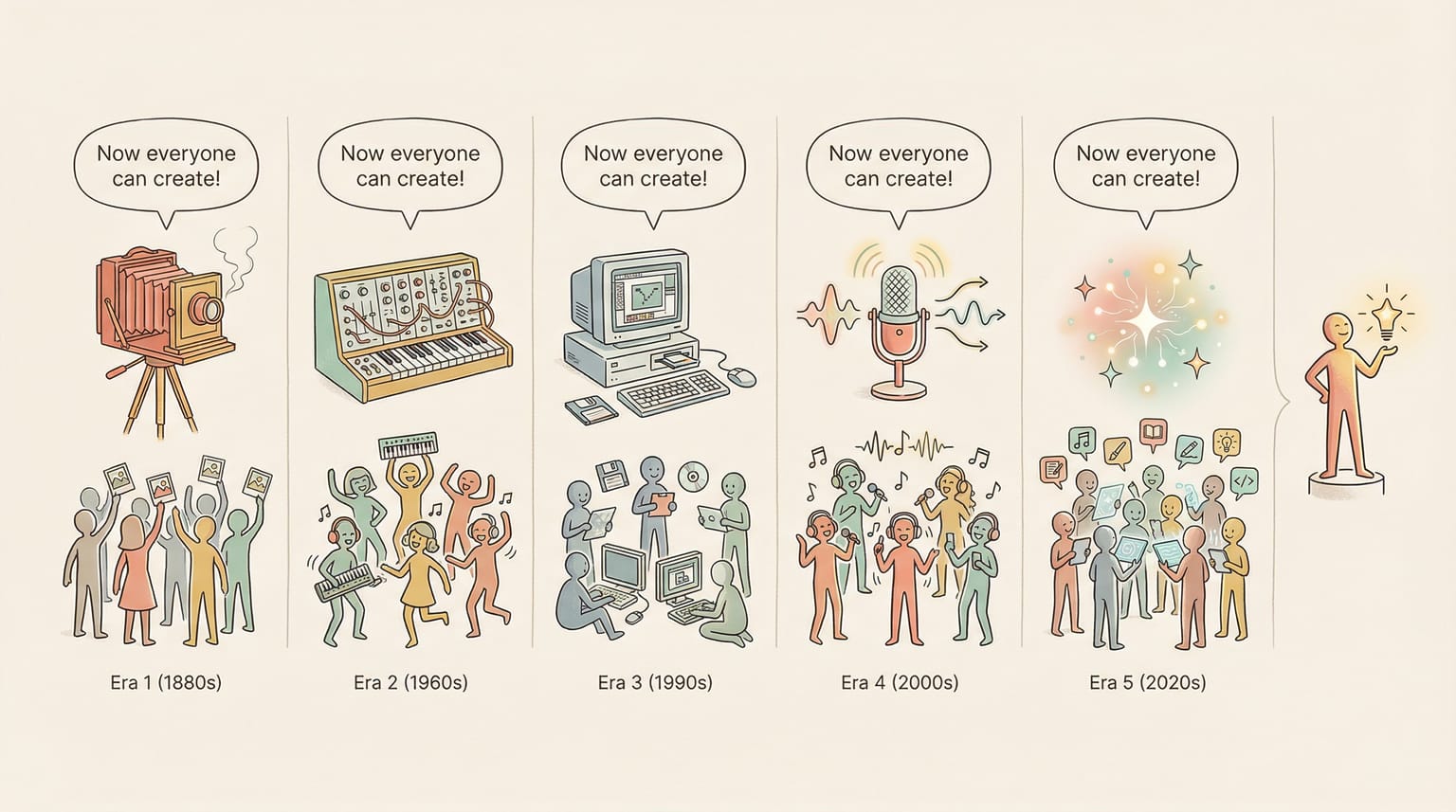
Every few decades, a new technology promises to democratize creativity. The camera. The synthesizer. Photoshop. Auto-Tune. Each time, the same prediction: now everyone can be a creator. Each time, the same result: the tool got easier, but making something great didn't. AI is the latest chapter in this story — and I'm living it right now.
The Pattern
Think about it. When the camera became affordable, the prediction was that professional photography would be over. Anyone could capture an image. And that was true — anyone could. But Ansel Adams wasn't Ansel Adams because he owned a camera. He was Ansel Adams because he had an eye.
When the synthesizer hit the market, the prediction was that anyone could make music. No orchestra needed. And that was true — the barrier to producing a track dropped to nearly zero. But having a synthesizer didn't give you taste. The charts didn't suddenly fill with masterpieces. They filled with noise, and the great musicians still rose to the top because they had something to say.
Photoshop. Desktop publishing. Auto-Tune. GarageBand. TikTok. The story repeats. The tool makes production easy. But production was never the hard part. The hard part was always knowing what to produce, why it matters, and when it's actually good.
Now it's AI's turn. And the prediction is louder than ever: AI will let everyone create professional content, videos, music, art. Anyone can be a creator now.
I use AI every day. I love it. And I'm here to tell you — that prediction is telling half the story.
What I Learned Creating with AI
I've been using AI to generate blog posts, videos, and images for weeks now. Not as an experiment — as my actual workflow. AI is how I produce content.
Here's what AI does brilliantly: first drafts. Variations. Visual generation. It takes ideas from my head and turns them into something tangible faster than I ever could alone. The speed is real. What used to take me a full day now takes a few hours. That part of the promise is true.
Here's what AI doesn't do: decide what's worth making.
It doesn't know when a generated image is almost right versus actually right. It doesn't bring personal experience or conviction. It can't tell you whether your blog post has a point or is just words arranged in a plausible order. It doesn't have taste.
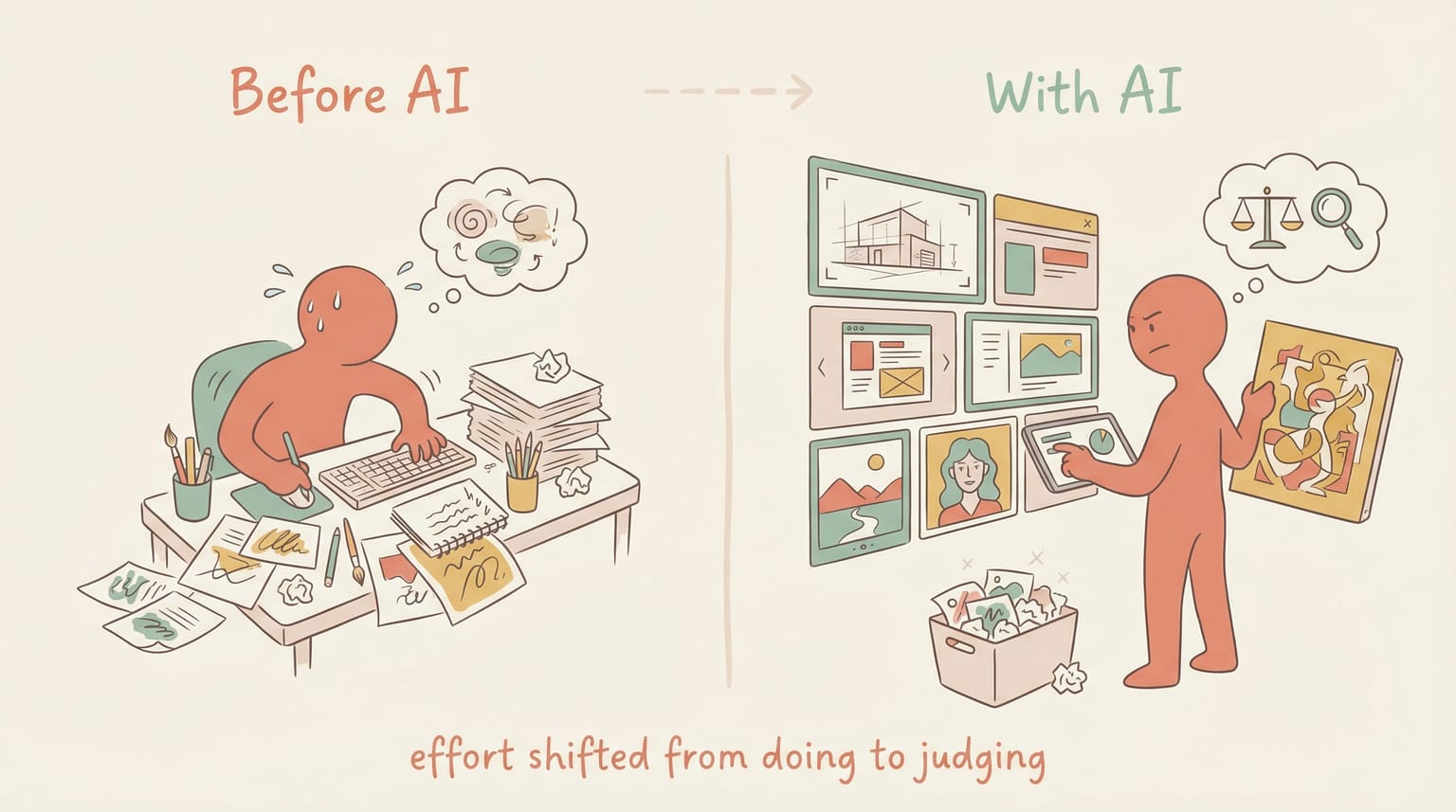
The effort didn't disappear when I started using AI. It shifted. I spend less time on execution — writing first drafts, generating visuals, formatting content. I spend more time on curation, refinement, and creative direction. More time deciding what to keep and what to throw away. More time asking: does this actually say something?
That shift is the part nobody talks about. The people who show you "I made this in 5 minutes with AI" aren't showing you the 2 hours they spent figuring out what to make, or the 30 iterations they threw away, or the final pass where they rewrote the parts that sounded like a robot wrote them.
The gap between "AI generated this" and "this is genuinely good" is still filled by the human.
The AI Slop Problem
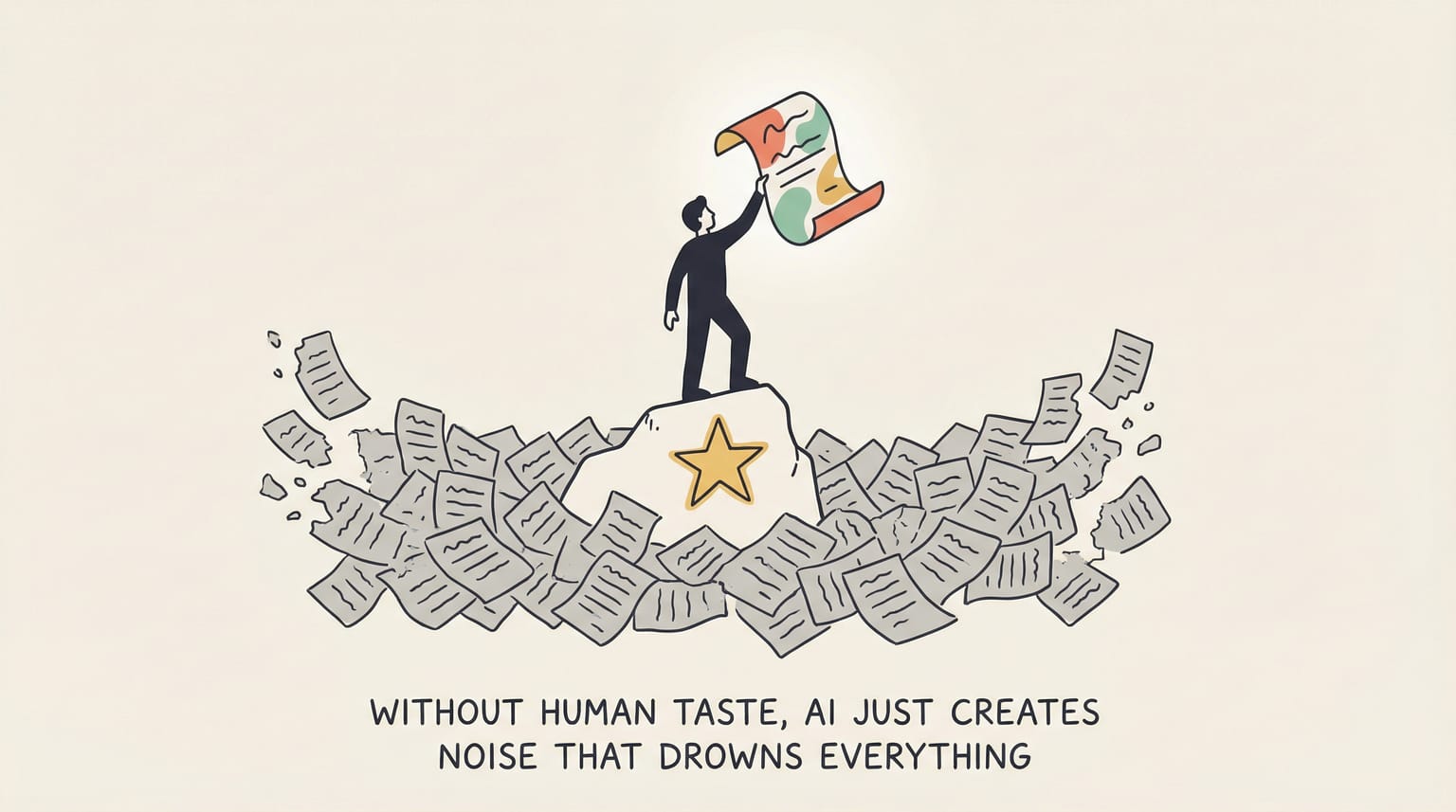
If AI made quality effortless, we'd be living in a creative golden age right now. Instead, we got "AI slop."
That term — AI slop — was named Word of the Year 2025 by both Merriam-Webster and the Australian National Dictionary. It describes the flood of low-effort, AI-generated content that's drowning the internet. And the numbers are staggering: research by Kapwing estimates that 21 to 33 percent of YouTube's feed may now consist of AI-generated junk content, generating around $117 million in ad revenue annually.
In January 2026, Bandcamp banned AI-generated music entirely. A survey found that 52 percent of consumers reduce engagement when they suspect content was made by AI. Audiences have developed what one researcher called a "sixth sense" for lazy AI — they can spot the overly enthusiastic adjectives, the repetitive structures, the lack of specific references that come from someone who clicked "generate" and called it a day.
The problem isn't AI. The problem is people who think the tool is the product.
A camera doesn't make a photograph great. Photoshop doesn't make a design great. And AI doesn't make content great. The tool is just the tool. What makes it great is the person behind it — their judgment, their taste, their willingness to throw away the first ten outputs and keep pushing until it's right.
The Hype Machine
So why does the narrative persist that AI can do everything?
Because it's a convenient story to tell. And many people repeat it — not because it matches their experience, but because it's the trend.
TechCrunch declared 2026 the year AI moves "from hype to pragmatism." The market is sobering up. But the hype machine is still running, fueled by people selling AI tools, AI courses, and AI-powered dreams.
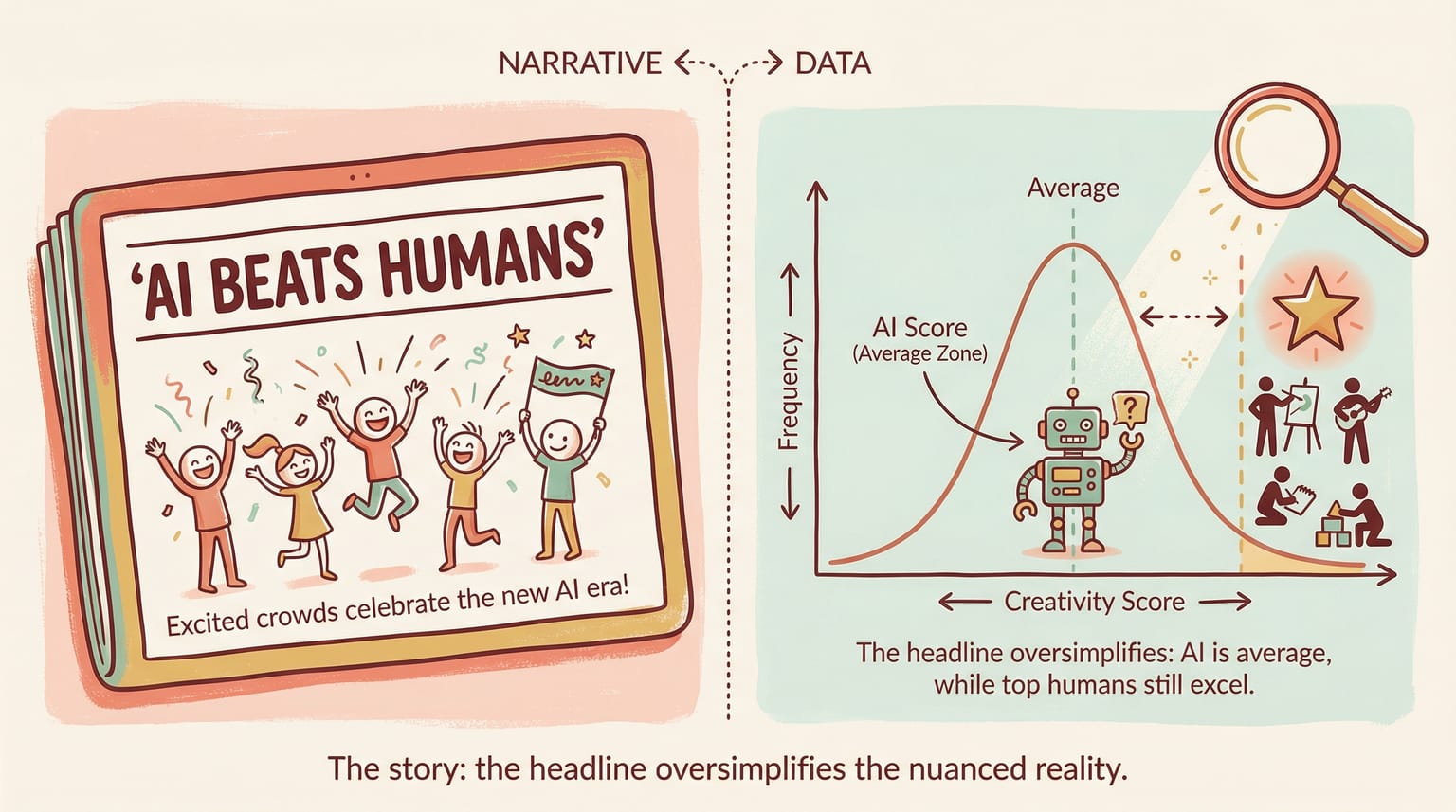
Here's a data point that tells the real story. Researchers tested AI against 100,000 humans on creativity. The headline: "AI beats humans." The actual data? AI beat the average human. But the top 10 percent of humans far outperformed every AI system tested. The best humans weren't close — they demolished the machines.
The headline says "AI beats humans." The data says "AI beats mediocre humans." That's a very different story.
There's a concept emerging called the "Humanity Moat." In a world where everyone has access to the same AI tools, the competitive advantage isn't the tool — it's trust, authenticity, and taste. The things AI can't generate.
The people telling you AI makes everything effortless are usually selling something. The people actually building with AI every day know the truth: AI is incredible, and it still requires you to show up with something worth amplifying.
AI Is a Power Tool, Not a Magic Wand
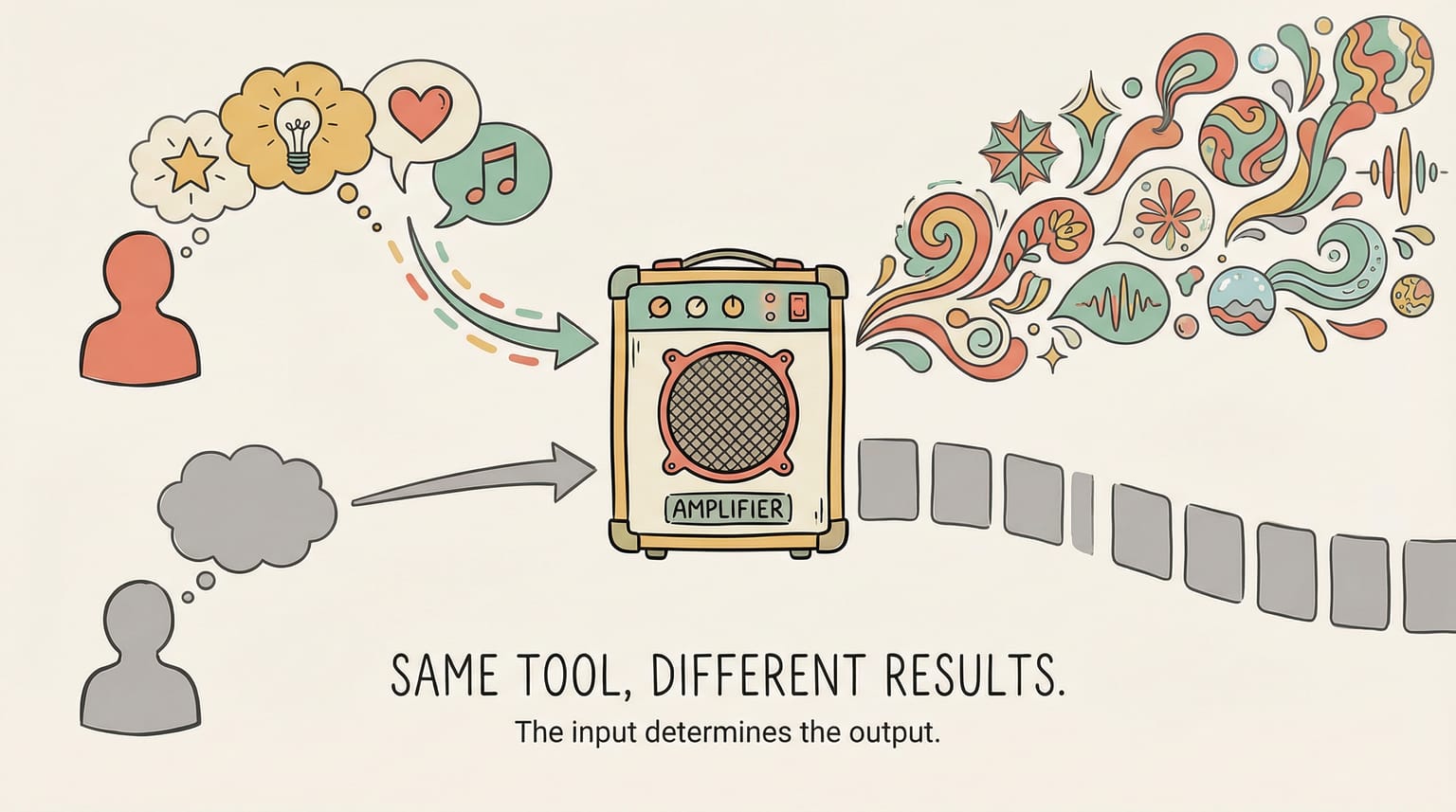
Here's the mental model I've landed on after weeks of building with AI: AI is the best amplifier ever built.
If you have taste, vision, and something to say — AI makes you 10x faster. It handles the grunt work so you can focus on the creative decisions. It generates variations so you can choose the best one. It turns rough ideas into polished outputs in minutes instead of hours.
If you don't have taste, vision, or something to say — AI helps you produce generic content faster. That's it. Faster mediocrity.
A survey of 1,100 music producers found that what they want from AI is tools that "save time without flattening creativity." They want amplification, not replacement. They want the instrument to be powerful while the musician stays in charge.
This is the right analogy. AI gives everyone a camera. It doesn't give everyone an eye. AI gives everyone a studio. It doesn't give everyone a song worth recording.
I want to be very clear: this is not an argument against AI. I use it every single day. It has genuinely transformed how I work. I produce more, I iterate faster, I explore ideas I wouldn't have attempted before.
But I'm not confused about what's happening. AI is doing the heavy lifting on execution. The taste, the judgment, the perspective — that's still me. And that's the part that makes the work actually good.
The Constant
Technology changes. The fundamental equation doesn't.
In the age of the printing press, the bottleneck wasn't printing — it was having something worth printing. In the age of YouTube, the bottleneck isn't uploading — it's having something worth watching. In the age of AI, the bottleneck isn't generating — it's having something worth generating.
The creators who will thrive in the AI era aren't the ones who lean on AI the hardest. They're the ones who know what they want to say — and use AI thoughtfully to say it better.
AI is the best creative tool of our generation. Use it. Embrace it. But don't mistake the tool for the talent.
Technology was never the bottleneck. Your taste, your judgment, your perspective — that was always the hard part. It still is.
I write about building with AI every week — the real experience, not the hype. If you want honest takes on what actually works, subscribe to Ship with AI.