AI Made Me 10x More Productive. Then I Almost Burned Out.
I've been running 5 AI agents in parallel, shipping content, generating videos, and automating workflows. I was more productive than ever. Then I hit a wall — not because AI failed, but because I was using the wrong mode for the wrong task.
This is the part nobody warns you about.
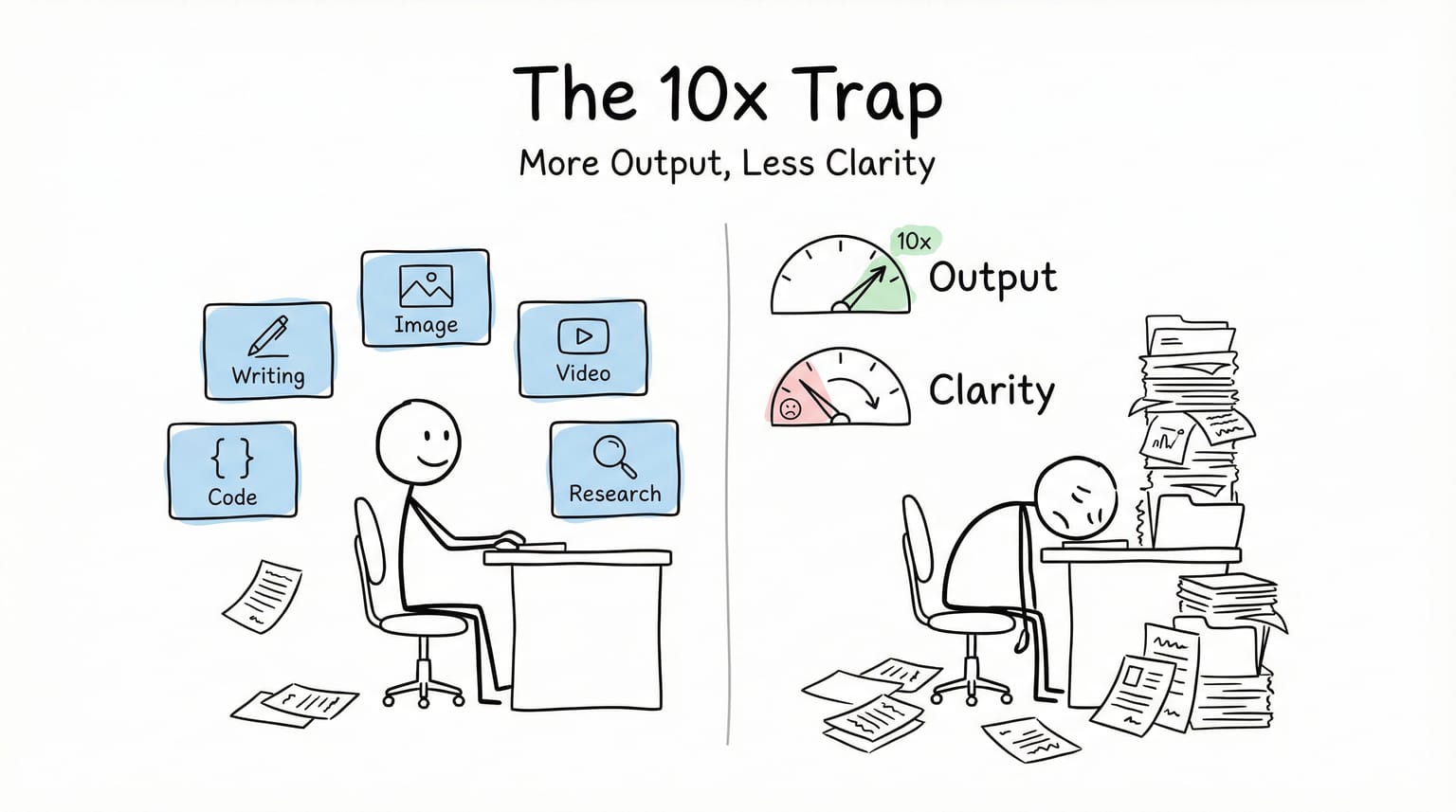
The 10x Trap
A few weeks ago, I built an AI content pipeline that goes from a rough idea to a published blog post, illustrations, a video, and distribution across X and newsletter — all AI-assisted. I was running multiple agents simultaneously: one generating images, another drafting copy, a third assembling video. It felt like a superpower.
And the numbers backed it up. I was producing more than ever. What used to take me a full week took a day and a half. I was a one-person content studio.
But something was off. I was shipping faster, yet I felt more tired — not less. My decision quality was dropping. I'd review my own output and catch mistakes I normally wouldn't make. I was switching between five parallel tasks and doing none of them with the attention they deserved.
More output. Less clarity. I'm not alone in this.
The Research Backs It Up
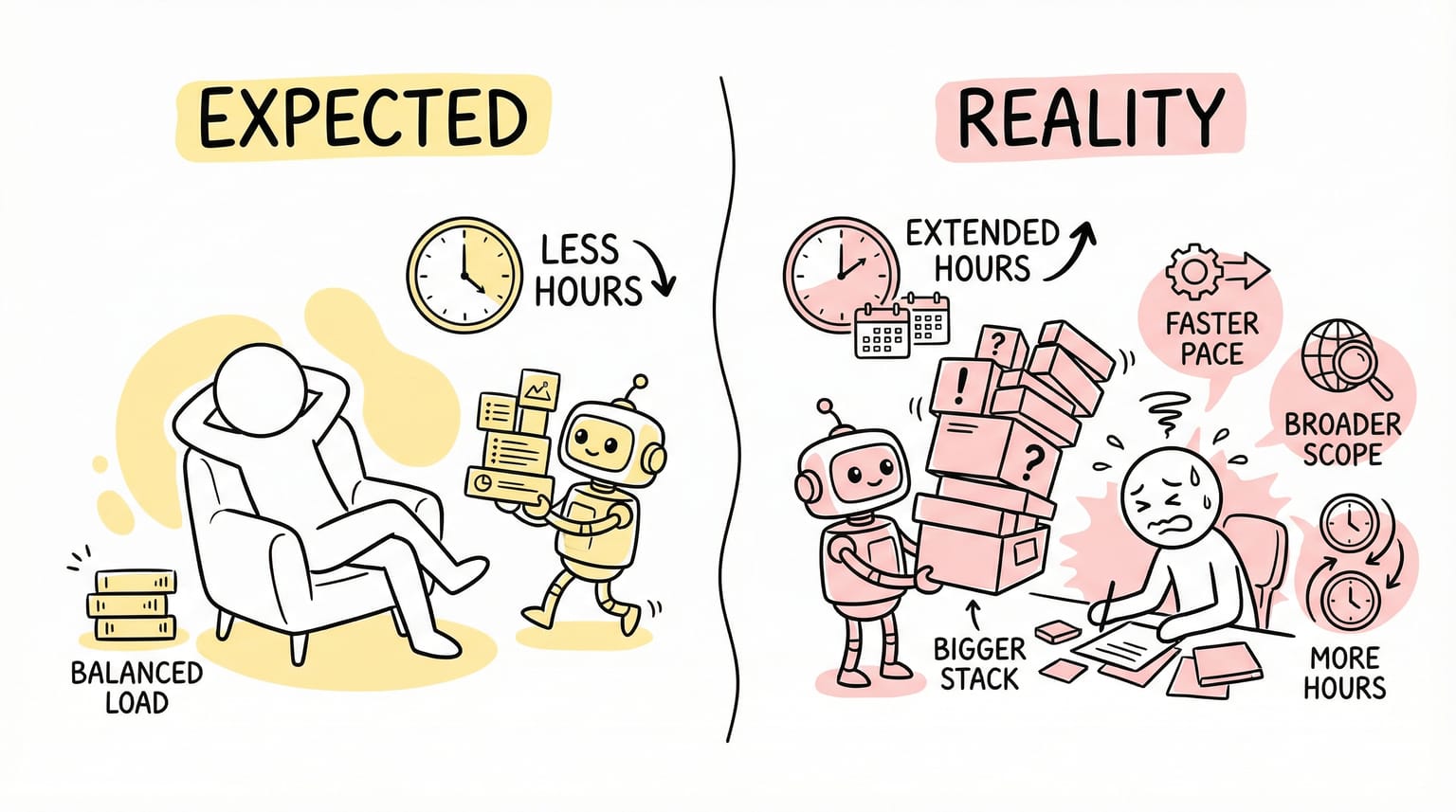
In February 2026, a UC Berkeley research team published a study that went viral. The headline: AI doesn't reduce work — it intensifies it. Workers who adopted AI tools didn't work less. They took on a broader scope of tasks, worked at a faster pace, and extended work into more hours of the day. As one worker put it: "You had thought that maybe you could work less. But you don't work less. You just work the same amount or even more."
Harvard Business Review identified three forms of AI work intensification: task expansion (you take on things you used to delegate), blurred boundaries (you prompt AI during lunch, commute, evenings), and increased multitasking (you manage parallel AI workflows on top of your regular work).
The most striking finding came from TechCrunch: the most enthusiastic AI adopters are burning out first. The people who embraced AI the hardest are the ones hitting the wall. Not the skeptics. The believers.
Meanwhile, thousands of CEOs surveyed in early 2026 admitted AI had no measurable impact on their companies' productivity. The Solow paradox — "you can see the computer age everywhere except in the productivity statistics" — is back, repackaged for AI.
The problem isn't the tool. The problem is that we don't have a framework for how to use it.
Kahneman Had the Answer 15 Years Ago
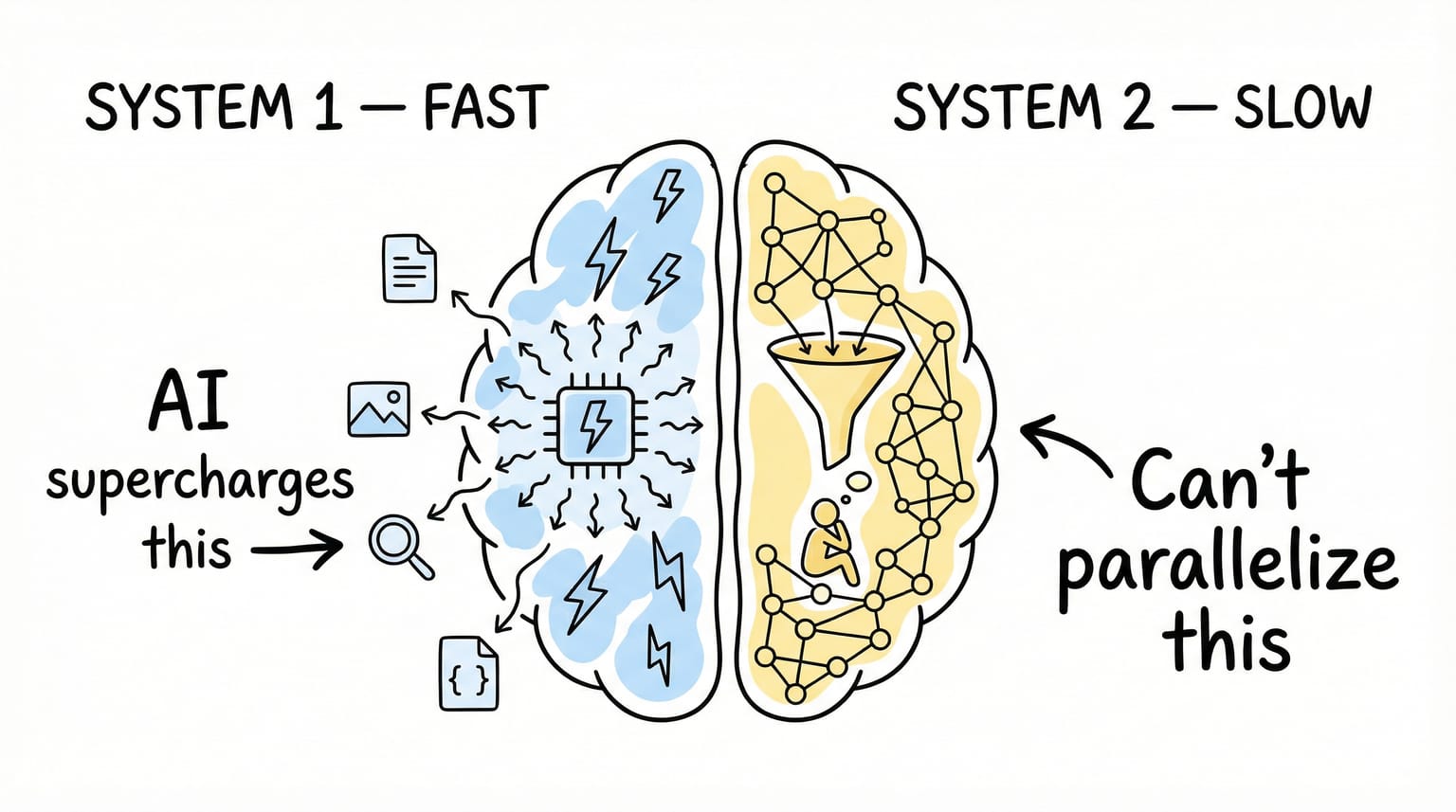
Daniel Kahneman's Thinking, Fast and Slow introduced a framework that explains exactly what's happening. He described two systems of thinking: System 1 — fast, intuitive, automatic — and System 2 — slow, deliberate, effortful.
System 1 is how you recognize a face, react to a loud noise, or skim an email. It's quick and low-cost. System 2 is how you solve a complex math problem, make a difficult career decision, or debug a subtle software issue. It's slow and draining.
Here's the connection: AI is the greatest System 1 accelerator ever built. It makes fast work faster. Drafting, generating, researching, scaffolding, exploring — all the parallel, generative tasks that benefit from speed and breadth — AI supercharges them.
But System 2 work — deep reasoning, judgment, resolving contradictions, making calls where the answer isn't obvious — can't be parallelized. You can't run five deep thoughts simultaneously any more than you can have five serious conversations at the same time.
We've known this tension for decades. Some people thrive in divergent, exploratory thinking — brainstorming, ideation, switching between threads. Others do their best work in convergent, focused thinking — going deep on one problem until it breaks open. The left brain / right brain distinction is a myth, but the underlying intuition is real: different tasks require fundamentally different cognitive modes.
AI didn't create this tension. It amplified it. And most of us haven't adapted.
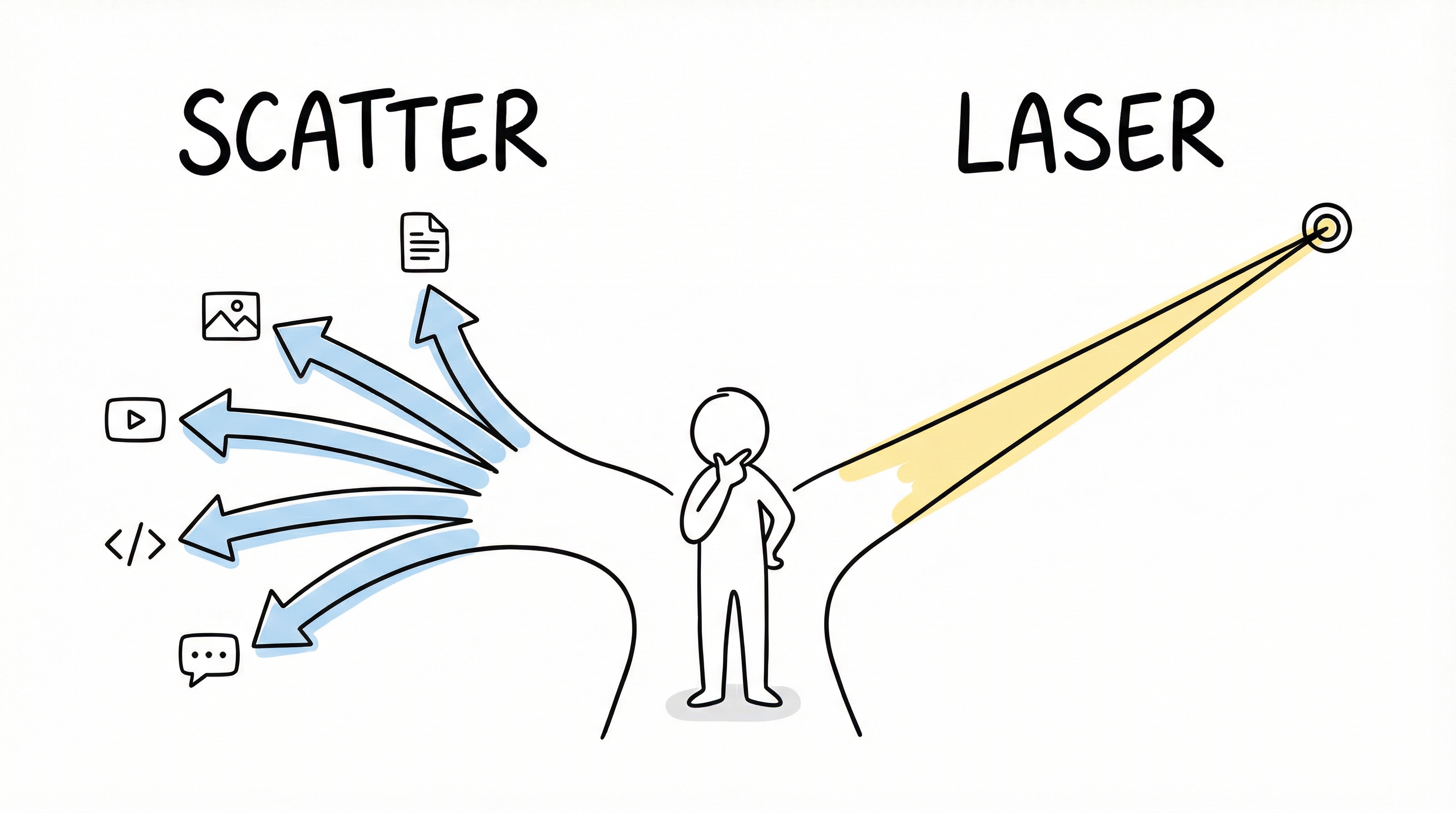
Two Modes: Scatter and Laser
After hitting my own wall, I started paying attention to when AI made me better and when it made me worse. The pattern was clear. It wasn't about using AI more or less. It was about matching the right mode to the right task.
I call them Scatter Mode and Laser Mode.
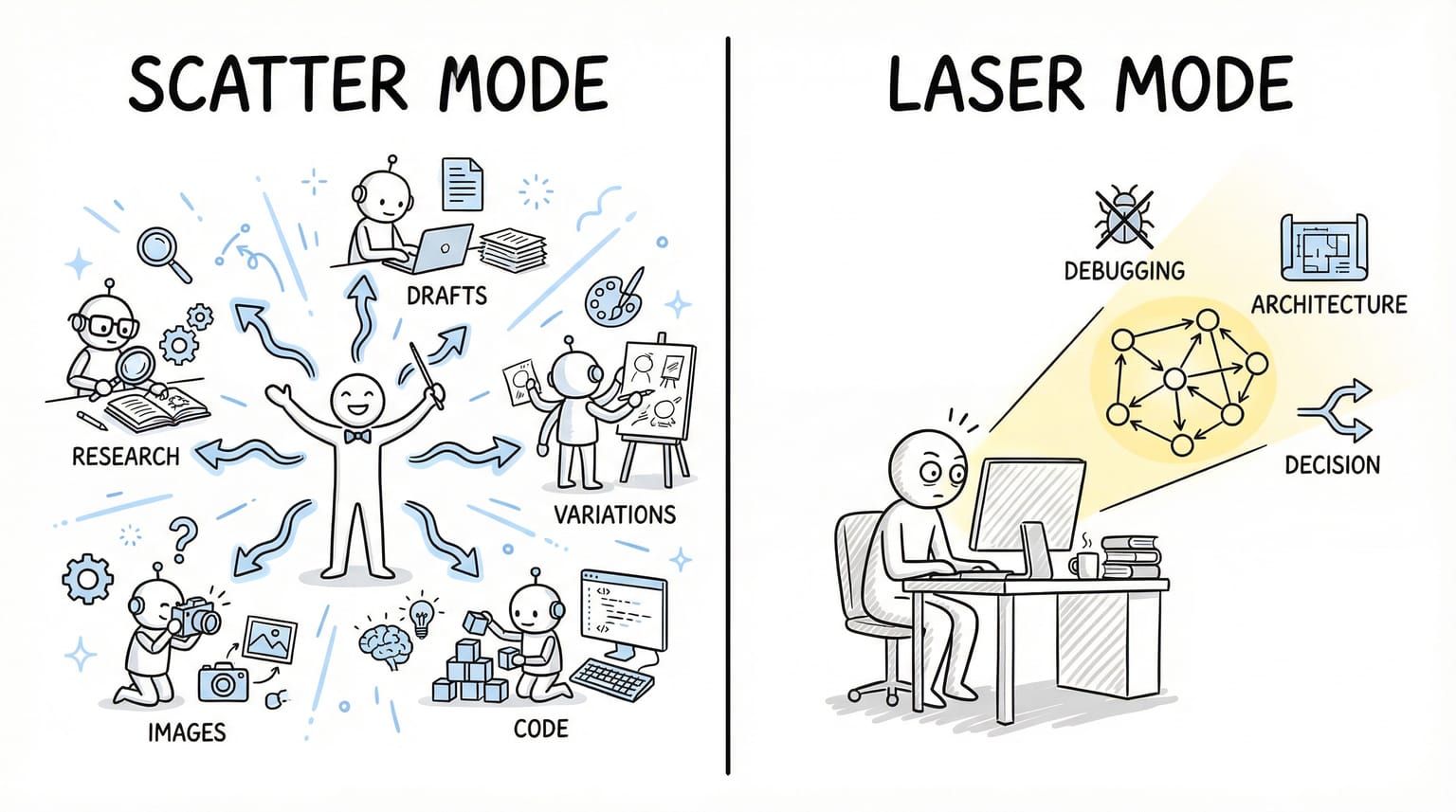
Scatter Mode is parallel, exploratory, and AI-amplified. It's System 1 on steroids. This is when you want breadth:
- Researching a topic across multiple sources simultaneously
- Generating drafts, variations, and options
- Running parallel AI agents on independent tasks
- Exploring new ideas, prototyping, scaffolding code
- Building a content pipeline: blog, video, images, distribution
Scatter Mode is where AI shines brightest. You can run five agents, explore ten directions, generate twenty variations — and converge later. The key word is independent. If the tasks don't depend on each other, scatter them.
Laser Mode is sequential, focused, and human-led. It's System 2, protected from distraction. This is when you need depth:
- Debugging a subtle, layered problem
- Making a product architecture decision with competing tradeoffs
- Polishing a piece of writing until it says exactly what you mean
- Designing a complex workflow where every step depends on the one before it
- Having a difficult conversation with a teammate
Laser Mode is where the human is irreplaceable. You can use AI here — a single, focused conversation — but you can't parallelize. The work requires holding the entire problem in your head, following chains of dependency, and exercising judgment that only comes from deep engagement.
The insight that changed my workflow: the mode matters more than the tool. AI in Scatter Mode (five agents generating options) is a completely different thing from AI in Laser Mode (one focused dialogue solving a hard problem). Same tool. Different cognitive context. Wildly different results.
What I Actually Do
Here's how this plays out in my daily work.
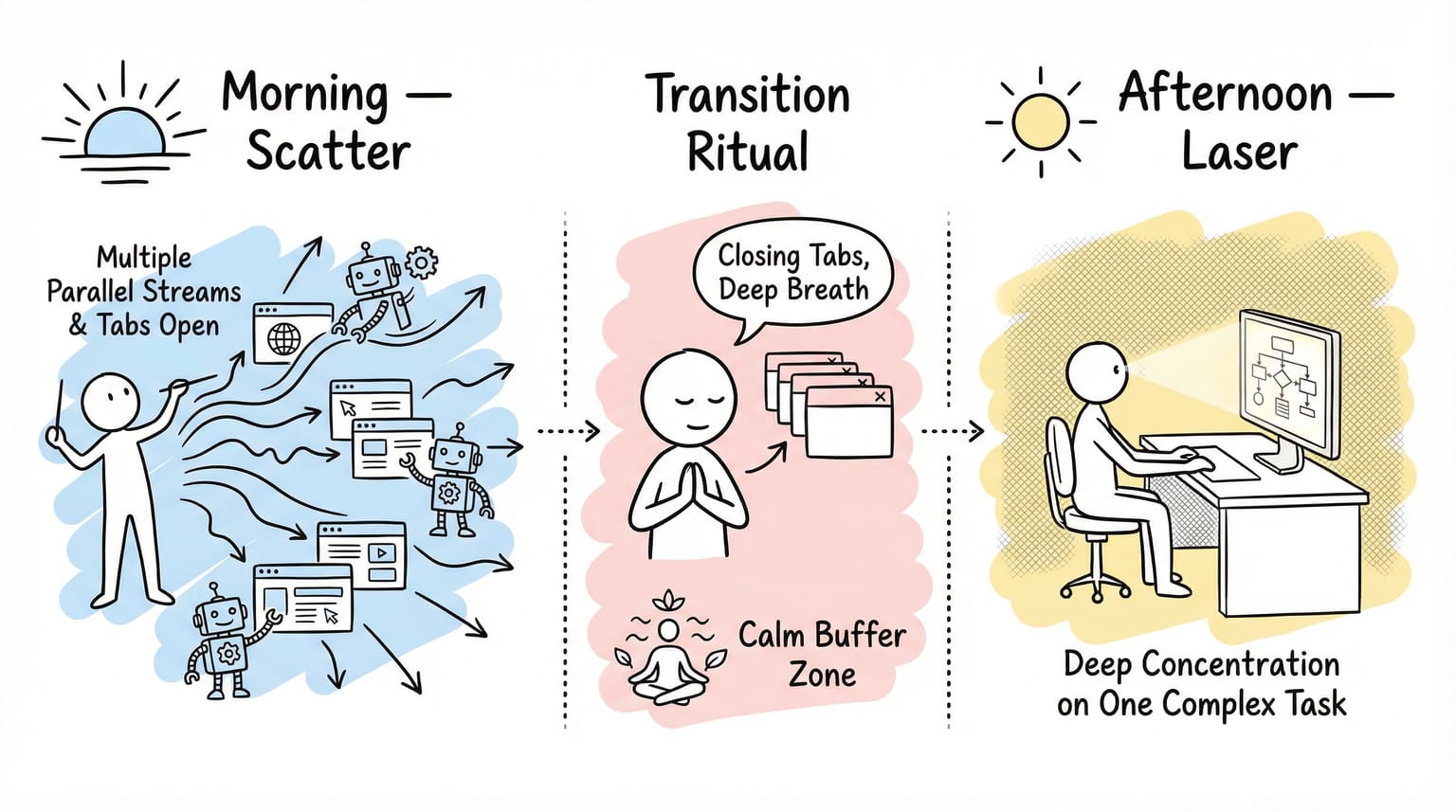
Mornings are for Scatter Mode. I start the day with exploratory, generative work. Research across multiple topics. Kick off parallel AI tasks — image generation, draft writing, code scaffolding. Queue up things that can run in the background while I move between threads. This is when I feel most like a conductor — orchestrating multiple streams, not executing any one of them deeply.
Afternoons are for Laser Mode. I close the parallel streams. One problem. One screen. Sometimes one AI conversation, but often just me and the code or the document. This is where I make the hard calls: product decisions, workflow design, debugging something that resists easy answers.
My rule of thumb: If the task has dependencies or requires judgment calls between competing tradeoffs — go Laser. If it's exploratory, generative, or the subtasks are independent — go Scatter.
The transition ritual matters. Switching from Scatter to Laser isn't instant. I close tabs, stop background agents, and give myself a five-minute buffer to shift cognitive gears. Going from "managing five parallel streams" to "solving one hard problem" requires a mental reset. Trying to jump straight from Scatter to Laser is how mistakes happen.
The Constant Is You
In my last post, I wrote that AI is the best amplifier ever built. I still believe that. But now I see a more nuanced picture.
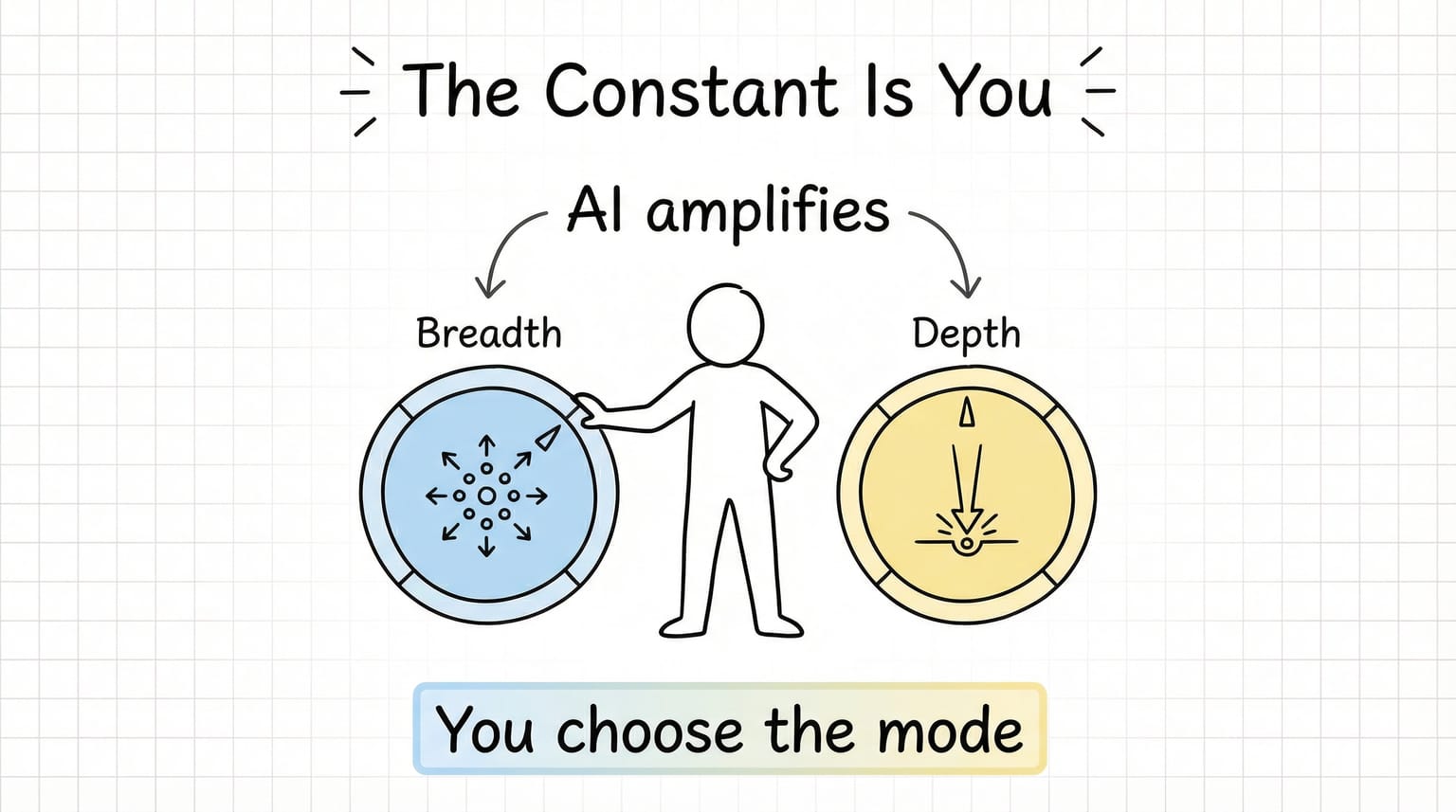
In Scatter Mode, AI amplifies your breadth — how many directions you can explore, how many options you can generate, how many tasks you can run in parallel. In Laser Mode, AI amplifies your depth — the quality of your reasoning, the precision of your output, the speed at which you reach a well-considered decision.
But in both modes, the human chooses. You decide when to scatter and when to focus. You decide when breadth serves you and when it's just noise. You decide when to let five agents run and when to shut everything down and think.
The people who will thrive in the AI era aren't the fastest multitaskers or the deepest focusers. They're the ones who can switch between both — who know that the meta-skill isn't using AI, but knowing which mode to be in.
Kahneman was right: knowing when to think fast and when to think slow has always been the human edge. AI just raised the stakes.
What's your experience? Do you find yourself stuck in one mode — always scattering or always lasering? I'm genuinely curious. Reply and tell me.
I write about building with AI every week — honest takes on what actually works. Subscribe to Ship with AI for the real story.