
Optimistic Concurrency
Optimistic Concurrency Control
- Last updated
- Jul 16, 2026
- Relationships
- 6
Mental model
Let people work in parallel; when someone commits, verify that the assumptions they started from are still true.
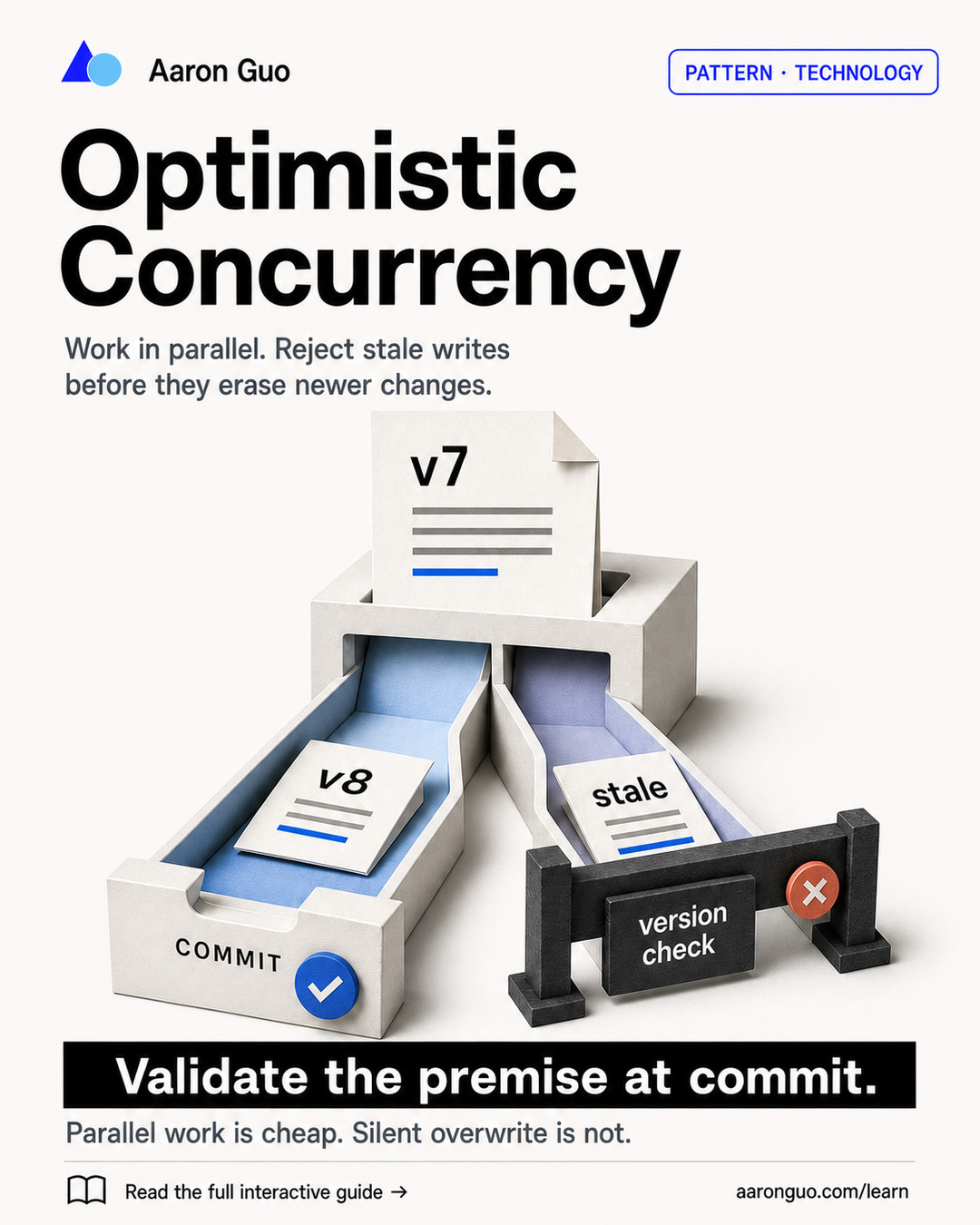
Visual memory card
The pattern, in one image.
A compact visual makes the pattern easier to recognize when it appears in a different example.
01 · Conflict lab
Create one stale write on purpose.
Alice and Bob begin from the same version. Step through the moment an invisible overwrite becomes a visible, recoverable conflict.
Not read yet
Waiting
Q3 Plan
version 7Not read yet
Waiting
The database is at version 7. Neither editor has read it yet.
02 · Strategy switch
Optimistic and pessimistic systems pay different costs.
The choice is not “safe versus unsafe.” It is whether ordinary work should pay with waiting or rare conflicts should pay with rework.
Everyone works; the commit point checks the ticket.
No conflict means almost no waiting. A collision means at least one participant must retry, merge, or stop.
- Best when
- Low contention
- Main risk
- Retry storms
03 · Concept neighborhood
Acronyms become useful when you know what kind of thing each one is.
OCC is a strategy. Its neighbors include a storage model, an atomic primitive, transaction semantics, retry safety, and merge models.
MVCC
storage modelMulti-Version Concurrency Control
Keeps versions so readers can see consistent snapshots.
CAS
atomic primitiveCompare-and-Swap / Compare-and-Set
Changes a value only while it still equals the expected value.
Isolation
semanticsTransaction Isolation
Defines what concurrent transactions may observe.
Idempotency
retry safetyIdempotent Operation
Makes retrying safe from duplicate effects.
OT / CRDT
merge modelOperational Transformation / Conflict-free Replicated Data Type
Transforms or converges concurrent intent instead of only rejecting it.
PCC
strategyPessimistic Concurrency Control
Secures exclusive access before doing critical work.
04 · Judgment practice
Read the shape of the conflict, not just the definition.
Choose a scenario. The strongest design is often a hybrid, because different parts of the system have different contention and failure costs.
Choose a scenario to reveal the design judgment.
Optimistic Concurrency
Optimistic Concurrency Control (OCC) solves a deceptively simple problem: two people can read the same record, make different changes, and accidentally erase each other's work.
Its defining move is not to lock the record while everyone thinks. It lets work proceed, then validates the writer's original assumption at the moment of commitment.
The failure it prevents: lost update
Suppose Alice and Bob both read document #42 at version 7.
- Alice changes the title and saves first. The database advances to version 8.
- Bob is still editing the old version 7. He changes the owner field and submits the whole object.
- Without concurrency control, Bob's stale object can silently restore the old title.
That is a lost update. The dangerous part is not that two people read together. It is that Bob's write was accepted even though the premise behind it was stale.
The mechanism
OCC normally has three stages:
- Read the business data and a concurrency token such as a version number or Entity Tag (ETag).
- Work locally without holding a long-lived exclusive lock.
- Validate and write as one atomic operation. If the token still matches, commit and advance it. If not, report a conflict.
UPDATE documents
SET title = 'Q3 Growth Plan',
    version = version + 1
WHERE id = 42
  AND version = 7;
One affected row means version 7 was still current. Zero affected rows means the record changed after it was read.
The comparison and write must be atomic. A separate SELECT followed later by an unconditional UPDATE leaves a Time of Check to Time of Use (TOCTOU) race between the two statements.
The same idea in HTTP
Hypertext Transfer Protocol (HTTP) exposes this pattern with Entity Tag (ETag) and If-Match:
GET /documents/42
ETag: "v7"

PUT /documents/42
If-Match: "v7"
If the resource is no longer version 7, the server can reject the write with 412 Precondition Failed. The condition is evaluated where the write happens, not guessed by the client from an earlier read.
Optimistic versus pessimistic
| Dimension | Optimistic Concurrency Control | Pessimistic Concurrency Control |
|---|---|---|
| Default assumption | Conflicts are uncommon | Conflicts are likely or very costly |
| Control point | Validate at commit | Lock or queue before work |
| No-conflict cost | Little waiting | Lock and waiting overhead remain |
| Conflict cost | Retry, merge, or discard work | Usually wait rather than redo |
| Common risks | Retry storms, livelock, poor conflict UX | Deadlocks, timeouts, lower throughput |
A useful approximation is:
optimistic cost ≈ validation + conflict probability × redo cost
pessimistic cost ≈ locking + waiting + deadlock/timeout handling
Real systems often mix them: optimistic editing for ordinary records, short locks or queues for a few hot resources, and idempotency keys around external side effects.
Conflict is part of the protocol
Detecting a conflict is only half the design. The product must decide what happens next:
- reject and ask the user to refresh;
- re-read and retry a deterministic operation;
- merge independent fields;
- show a three-way merge;
- serialize a hot resource through a queue or short transaction.
Automatic retry also needs idempotency, bounded retries, and backoff with jitter. Retrying an operation that sends money, email, or third-party requests can otherwise duplicate the side effect.
Where it fits
OCC is strongest when reads dominate writes, conflicts are rare, users may edit for a long time, and retry or merge is affordable.
It degrades when many requests fight over one hot record, conflicts invalidate expensive work, or a business invariant spans records that a single version token cannot protect.
What it is not
- Not Last Write Wins. OCC makes stale writes visible instead of silently accepting the last arrival.
- Not Multi-Version Concurrency Control (MVCC). MVCC mainly answers which version a reader sees; OCC answers whether a writer's premise is still current.
- Not Compare-and-Swap (CAS). CAS is an atomic primitive that can implement the broader OCC strategy.
- Not Optimistic User Interface. Optimistic UI changes perceived latency; OCC protects concurrent correctness.
Five things to keep
- OCC means “do not block first; validate the premise at commit.”
- The check and write must be atomic.
- Version, ETag, and CAS are carriers or mechanisms, not the complete policy.
- A conflict needs a designed exit: reject, retry, merge, or serialize.
- Choose between waiting and rework based on contention and failure cost, not ideology.
Relationships
Concept neighbors
PCC
strategyPessimistic Concurrency Control
Acquire exclusive access before doing the critical work, trading retries for waiting and lock management.
MVCC
storage modelMulti-Version Concurrency Control
Keep multiple versions so readers can see a consistent snapshot without blocking writers.
CAS
atomic primitiveCompare-and-Swap / Compare-and-Set
Replace a value only when it still equals the expected value; a common building block for OCC.
Isolation
semanticsTransaction Isolation
Defines what concurrent transactions may observe and which anomalies the database prevents.
Idempotency
retry safetyIdempotent Operation
Makes a repeated request produce the intended effect once, which is essential before automatic retries.
OT / CRDT
merge modelOperational Transformation / Conflict-free Replicated Data Type
Preserves concurrent intent by transforming or converging operations instead of simply rejecting one writer.
Evidence trail