
Context Language Models
Context Language Models
- Last updated
- Oct 6, 2026
- Relationships
- 2
Mental model
The trip gets longer. The budget and the child’s needs stay. The next call should see all three.
Visual memory card
The pattern, in one image.
A compact visual makes the pattern easier to recognize when it appears in a different example.
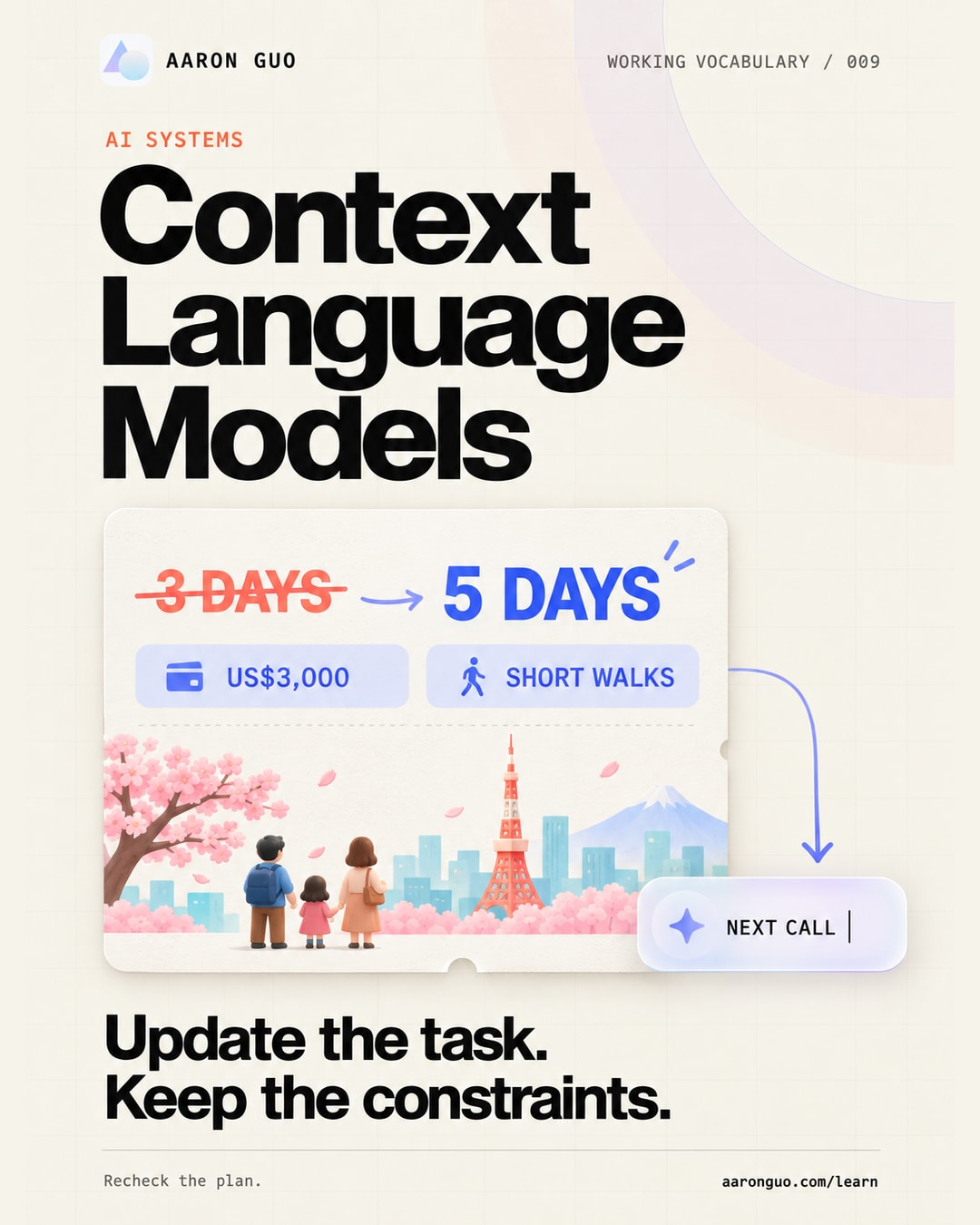
Imagine a father, mother, and daughter asking an AI to plan three days in Tokyo. Their total budget is US$3,000, and their daughter tires on long walks. Then they ask: “Make it five days.”
The duration changed. The budget and walking limit still apply. The next answer needs to account for all of them.
Context is the material supplied to this call
A model generates an answer from the instructions, conversation, and tool results supplied to that call. Think of those as papers on a desk: there may be many old plans, but the current job needs to be clear.
In September 2026, Rulin Shao and colleagues introduced Context Language Models (CLM), which let a model edit its own working context and organize the material carried into later work.
Update the days. Keep the other conditions.
For this hypothetical trip, an updated working record could look like this:
| Condition | Before | Now |
|---|---|---|
| Duration | 3 days | 5 days |
| Total budget | US$3,000 | US$3,000 |
| Family | Dad, mom, daughter | Dad, mom, daughter |
| Walking | Keep walks short | Keep walks short |
It should also retain new unfinished work: recalculate accommodation and transport for two extra nights. Updating a field does not prove the longer trip fits the budget.
The record must reach the next call. The official implementation mirrors editable context into a file, lets the model change it, and reads accepted changes back. System instructions and the original task stay pinned separately. The official harness documentation explains this handoff.
A habit you can borrow
When a task changes, ask:
Before continuing, list what changed, which conditions still apply, and what new work the change creates. Then continue using the updated requirements.
This helps you inspect task state. A prompt alone does not activate CLM, and the model can still omit a condition. The trip is an illustration, not a measured result.
To check whether an AI has kept up, start with the material it will use next: does it still accurately describe the job you now want done?
Relationships
Concept neighbors
Context Window
input boundaryContext Window
How much input a model can process in one call. A larger window still needs clear current requirements.
Task State
working recordTask State
The current goal, active constraints, decisions already made, and unfinished work.
Evidence trail