
I Engineered the Law of Attraction with AI
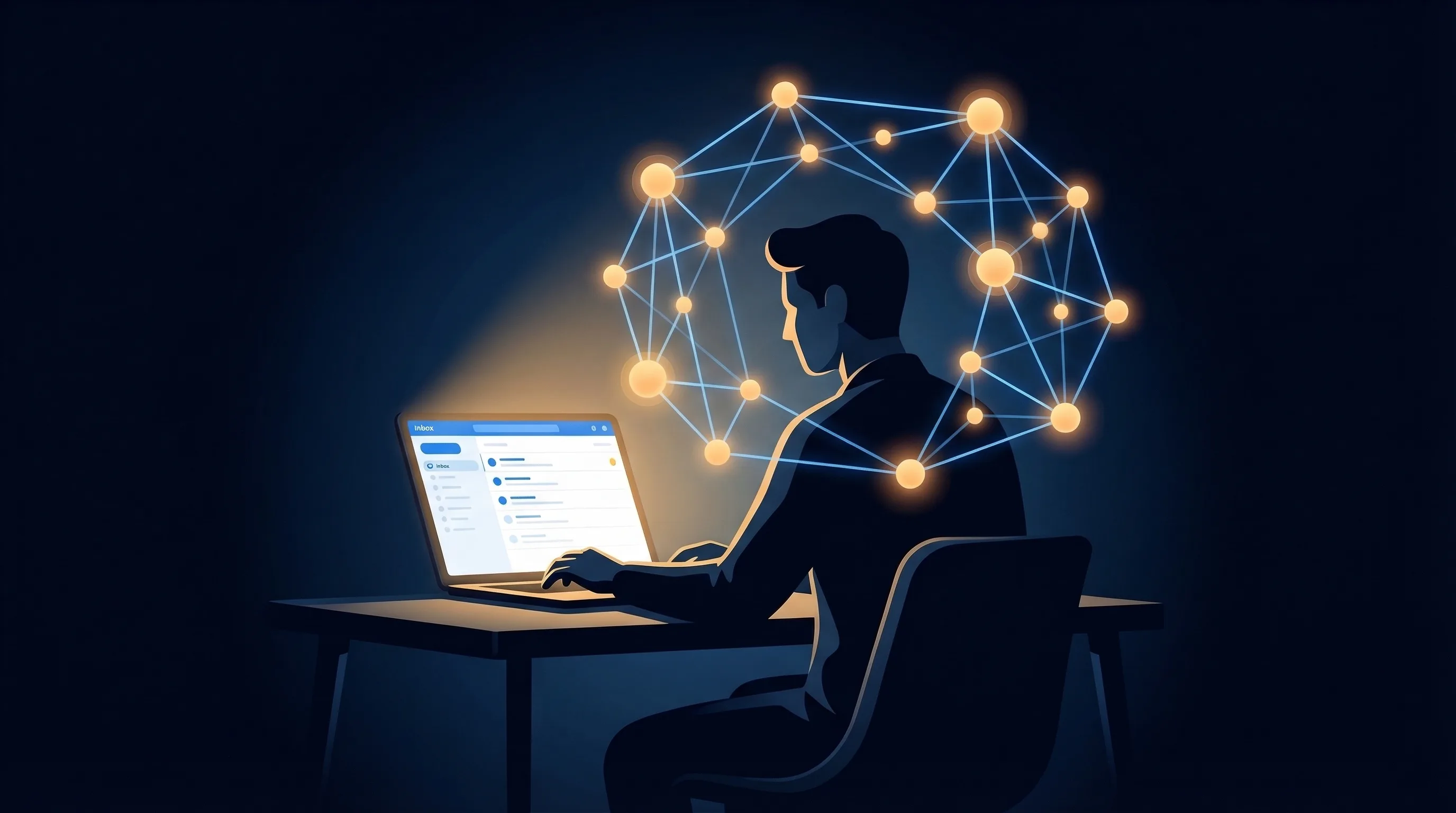
Every morning, before I open WhatsApp or check my phone, something arrives in my inbox.
It's a digest. Around 15-20 items — papers, posts, threads, projects — each with an AI-generated summary and a relevance score. The high-scoring items are my "must reads." Everything else I can skim or skip — and the ones worth keeping often make their way into my writing and blog posts.
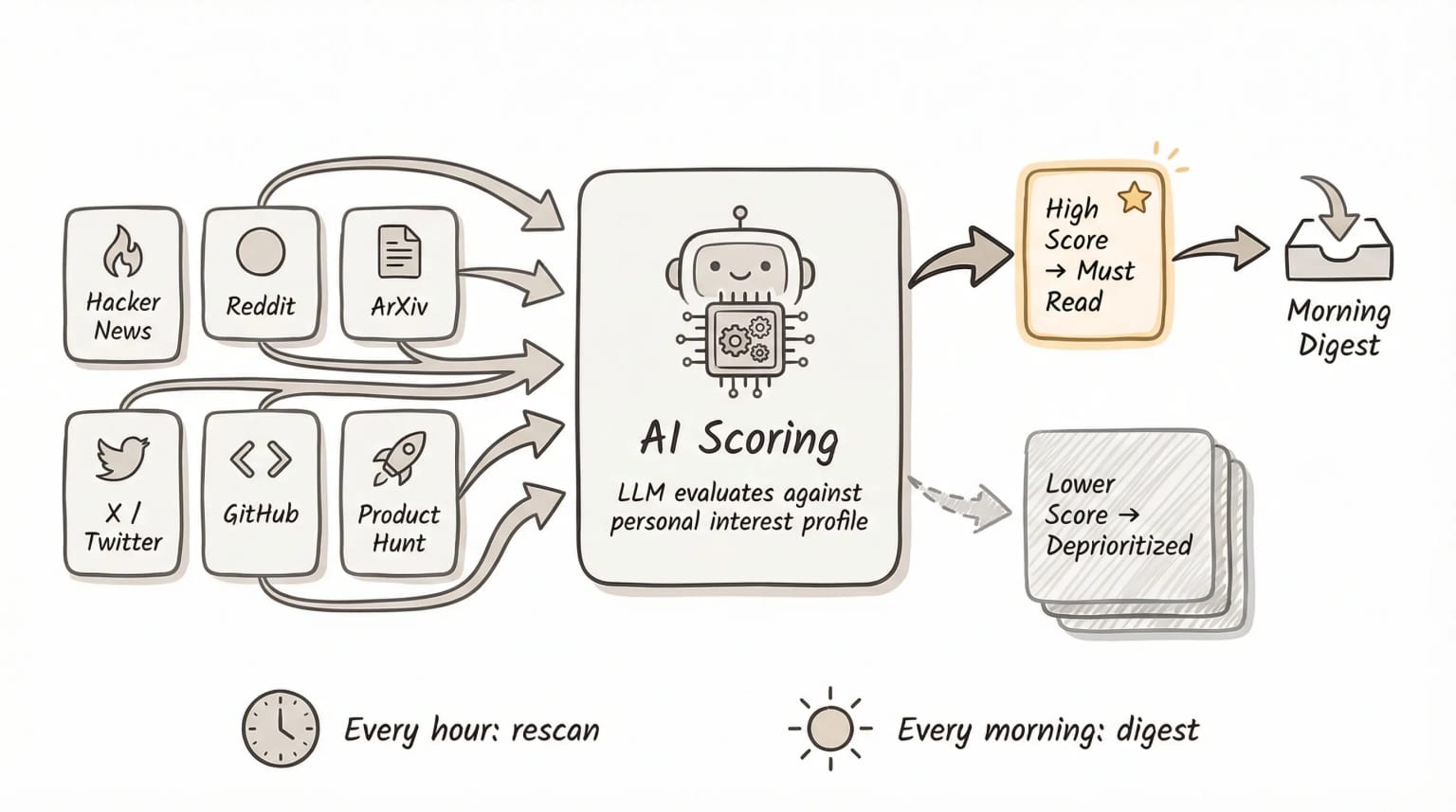
This system — I call it Signal — runs 24/7. It monitors Hacker News, Reddit, ArXiv, X, Product Hunt, GitHub Trending, and a few other sources. Every item gets scored by AI against a profile of my interests, goals, and blind spots. Every hour it rescans. Every morning it delivers.
I built Signal because I believe in the Law of Attraction. And I wanted a better version of it.
The Pattern I Couldn't Ignore
I've never been someone who dismissed the Law of Attraction as wishful thinking. I've lived it too many times to doubt it.
In university, I wanted to start a business. I had no capital, no business plan, no clear idea. What I had was obsession — I read about entrepreneurship, talked about it constantly, surrounded myself with people who were building things. A few months later, I was running a music instrument store with friends on campus. It wasn't the business I imagined. But it was a business.
Years later, I wanted to leave China and build a life abroad. I didn't have a clear path. I just kept moving toward it — learning, meeting people, taking the small steps that were available. Slowly, a series of doors opened. I immigrated to Canada.
Later, I wanted to work in finance. I took every opportunity to get closer to that world — conversations, roles, projects. And eventually, I became a partner at a finance firm.
None of these happened in a straight line. None of them happened because I simply wished hard enough. But all of them followed the same pattern:
Intense focus → Immersion → A series of "coincidences" that lined up → Action on those coincidences.
I didn't just want things. I saturated myself in the world of what I wanted. And then things found me.
What the Law of Attraction Actually Is
Strip away the mysticism and the mechanism is pretty clear:
- Intention — You define what matters to you
- Attention — You expose yourself to relevant information and people
- Pattern Recognition — Your mind starts filtering the world for relevant signals
- Action — You act on the "coincidences" that aren't coincidences
There's actual neuroscience behind step 3. Your brain's Reticular Activating System (RAS) processes roughly 11 million bits of information per second — but your conscious mind handles only about 40. The RAS is the filter. It decides what reaches awareness and what gets ignored.
When you set a clear intention, you reprogram the filter. Suddenly you notice the article that was always there, the person you should have met months ago, the opportunity that was sitting in plain sight.
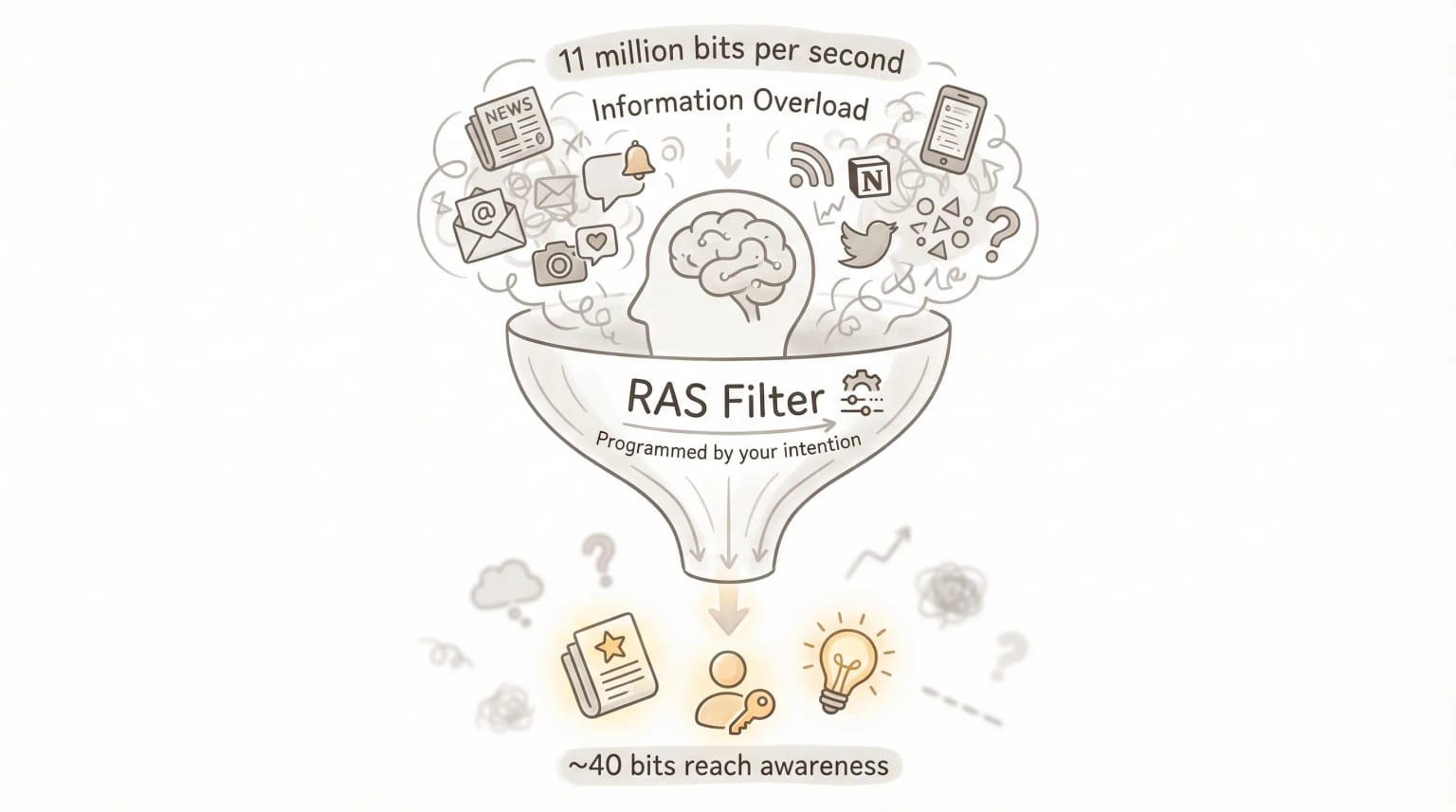
This is not magic. This is signal acquisition.
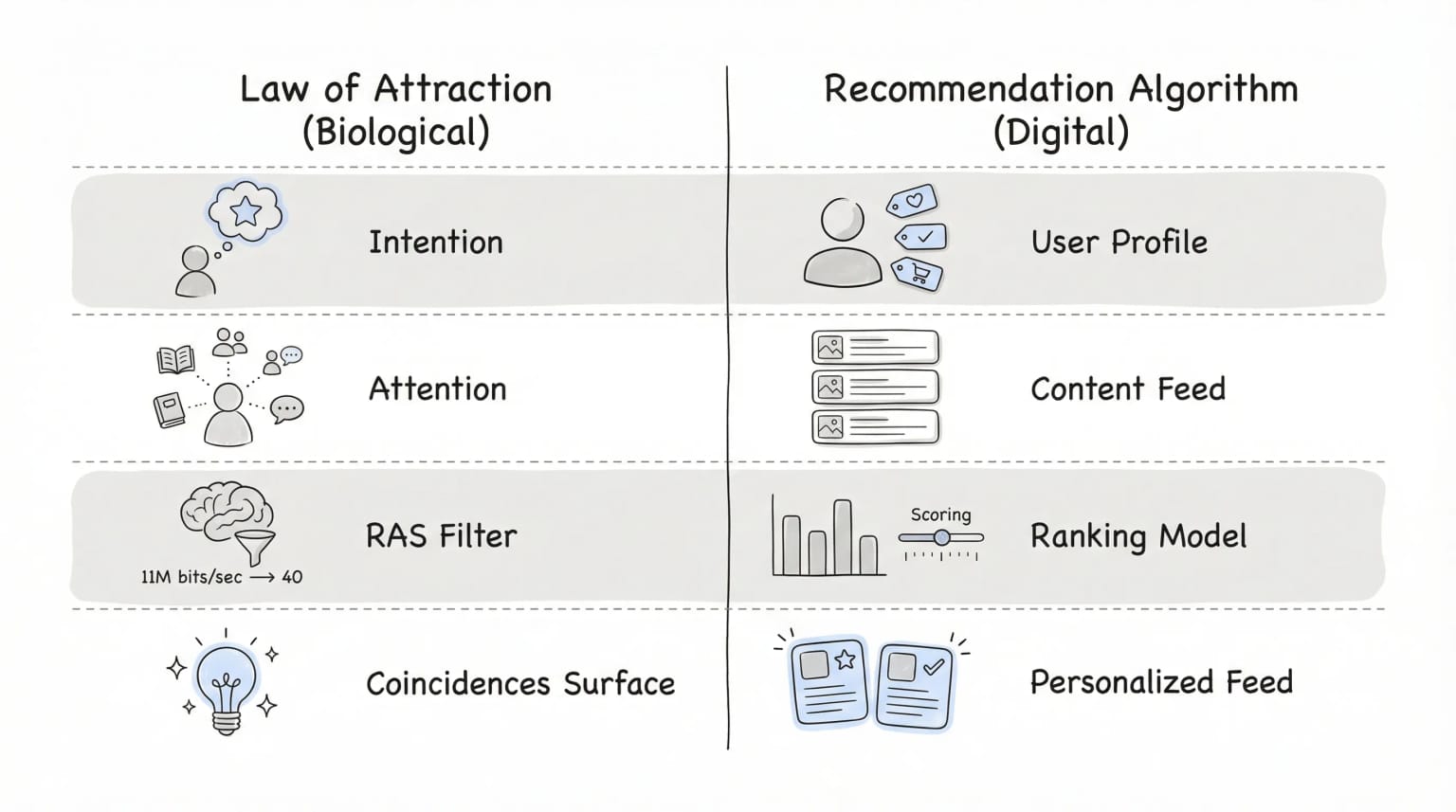
And here's the part that clicked for me: this is exactly how a recommendation algorithm works.
| The Law of Attraction | A Recommendation System |
|---|---|
| Set an intention | Define a user profile |
| Expose yourself to information | Ingest a content feed |
| RAS filters for relevance | Ranking model scores relevance |
| "Coincidences" surface | Personalized feed appears |
The Law of Attraction is a biological recommendation engine. And like any recommendation engine, it has a hard ceiling — bandwidth, processing speed, the finite hours you can read and connect and explore.
AI doesn't have those limitations.
How Signal Works
In early 2025 I started learning AI seriously — agents, LLMs, the whole landscape. One theme kept surfacing: the best AI researchers were pouring money into systems that build richer internal representations of the world, so machines could filter and reason more like humans do. Yann LeCun left Meta to build AMI Labs around this idea. Fei-Fei Li raised at a $5B valuation for World Labs. The direction was clear: the future of AI isn't just generating text, it's modeling what matters.
I wasn't trying to build AGI. I was trying to build a better filter for myself. That's when Signal came together.
The architecture is simple:
Sources → Hacker News, Reddit, ArXiv, X/Twitter, Product Hunt, GitHub Trending, Lobsters
Scoring → Every item is evaluated by an LLM against a personal interest profile: my current focus areas, the questions I'm trying to answer, the blind spots I want to address
Output → High-scoring items are "must reads." They hit my morning digest. Everything else is available but deprioritized.
Cadence → Rescan every hour. Daily digest every morning.
What this actually does:
- Expands my attention bandwidth roughly 100x. I "read" 500+ items a day through AI summaries. I decide which ones are worth full attention.
- Eliminates the noise loop. No doomscrolling. No algorithmic distraction designed to maximize my time on a platform, not my growth.
- Manufactures lucky coincidences. Papers I wouldn't have found. People I wouldn't have known to look for. Ideas I wouldn't have connected.
- Compounds over time. The sharper I define my interests, the sharper the signal gets.
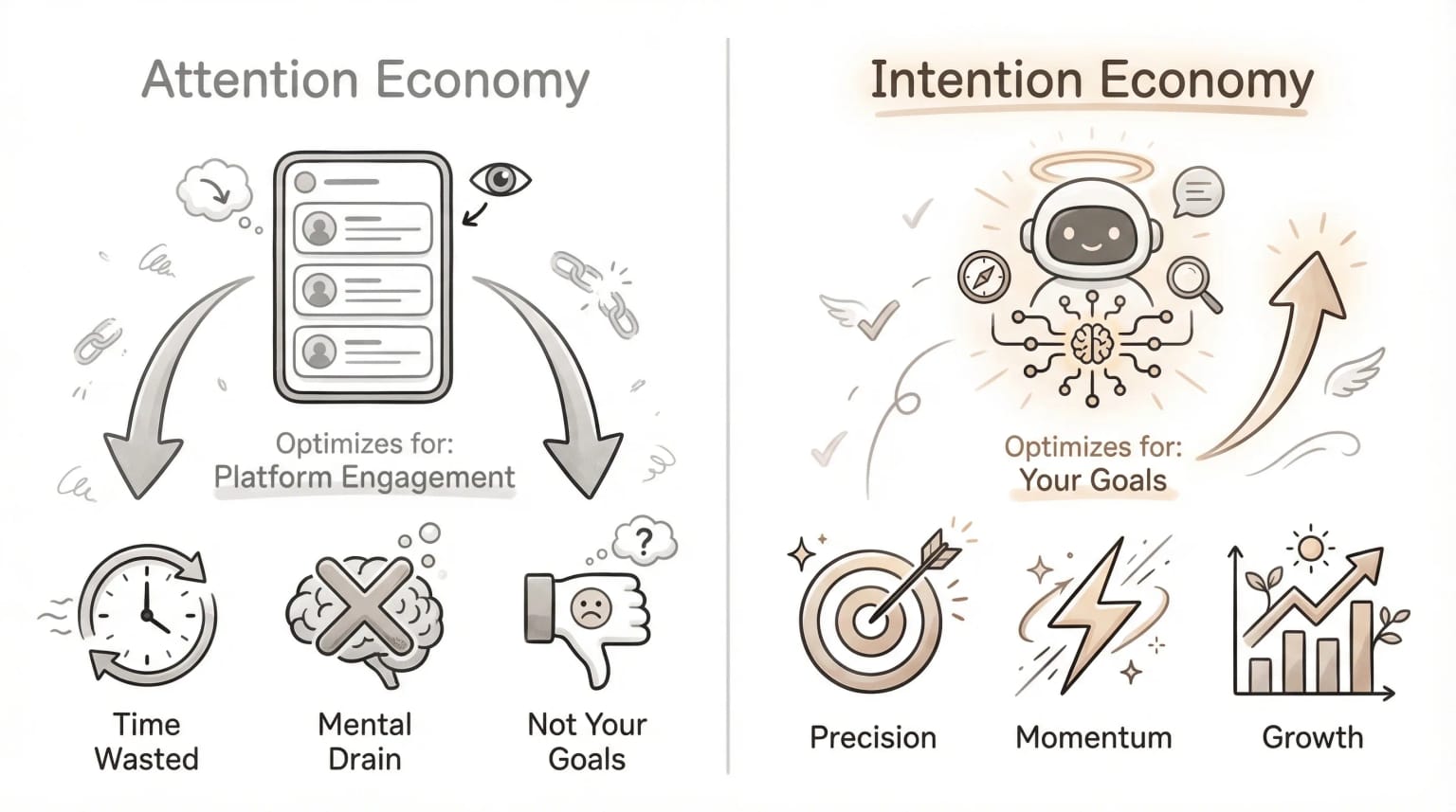
This is the shift the tech world is calling the move from the Attention Economy to the Intention Economy.
The attention economy — social media as we know it — optimizes for platform engagement. It captures your focus and sells it. The intention economy is different: systems that optimize for your goals, not the platform's metrics.
Researchers at Cambridge are already warning that AI will soon intercept your developing intentions in real time and sell them to advertisers. The arms race is coming either way. The question is whether you build your own system, or let someone else build one for you.
The Flywheel
The traditional Law of Attraction is passive: set your intention and wait for the universe to deliver. That framing always bothered me. It leaves too much to chance.
The AI-augmented version is an active flywheel:
Signal → captures what matters in your domain Knowledge → deepens as you process curated information every day Action → becomes more informed — better decisions, sharper writing, the right conversations Signal → improves as your actions generate new connections, new sources, new feedback
A concrete example: Signal started surfacing world model research in late 2025 — LeCun's papers, Jim Fan's robotics work, early coverage of AMI Labs. I went deep on it. I started writing and talking about world model applications in ways that weren't common yet. That positioned me in conversations I wouldn't have been part of otherwise. Those conversations fed new sources back into Signal.
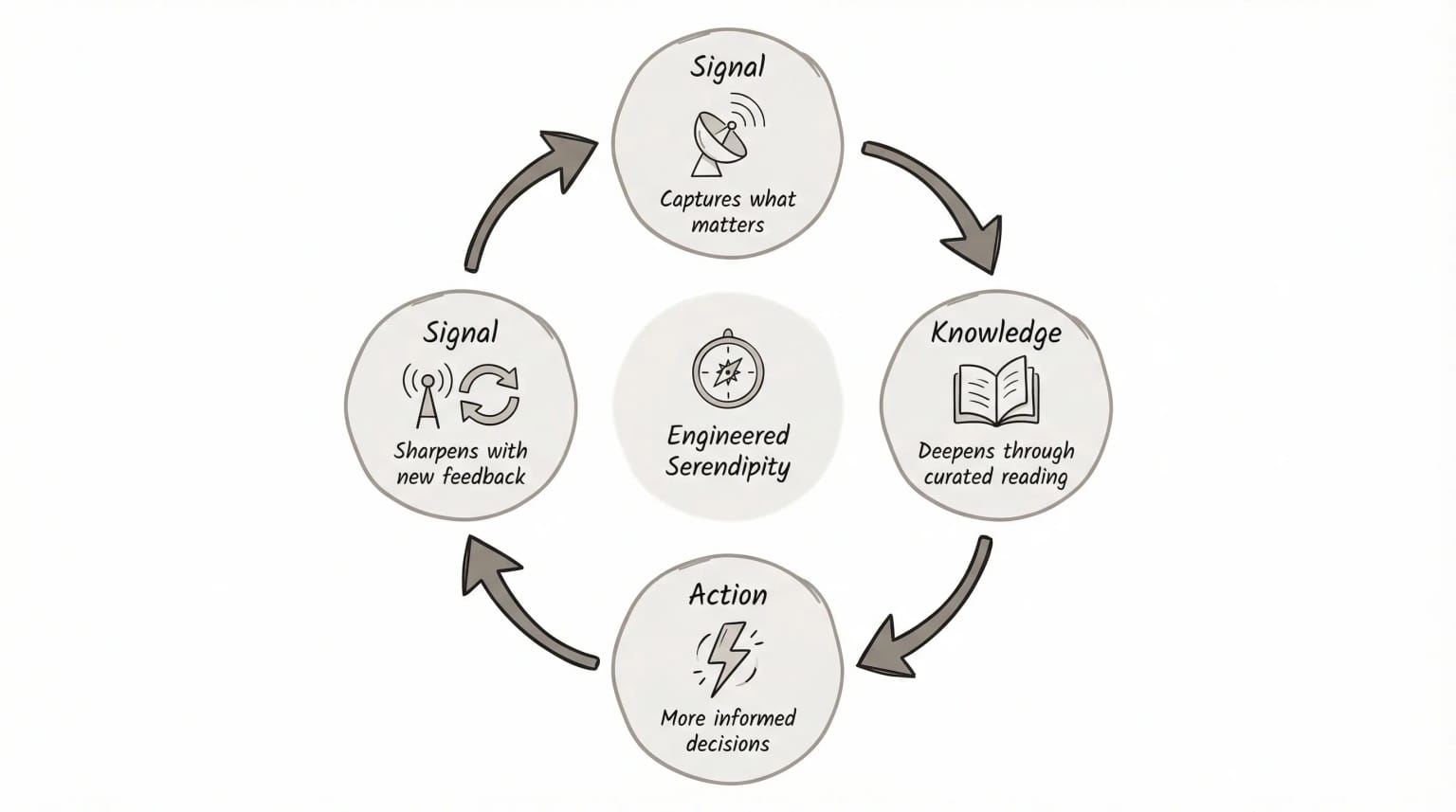
This is engineered serendipity — designing the conditions where valuable accidents happen more often.
It's not that the universe delivers. It's that you build a system that makes delivery more likely, more frequent, and more precisely targeted.
Why This Matters Now
We're in the age of information abundance and attention scarcity. The average person encounters thousands of pieces of content every day and retains almost none of it — because the algorithms deciding what they see are optimized for platform engagement, not personal growth.
The people who win in this environment won't be the ones with access to the best AI tools. Everyone has access to GPT now. What matters is whether you've built a system that uses AI in service of your specific intentions — consistently, automatically, while you sleep.
Signal didn't change how smart I am. It changed what I'm exposed to. And over time, what you're exposed to shapes what you know, who you meet, and what you're able to do.
That's not manifestation. That's architecture.
Build Your Own Signal
I didn't stop believing in the Law of Attraction. I just decided to engineer it.
The questions I'd ask anyone thinking about this:
- What are you trying to attract into your life right now?
- What information would you need to see — consistently, every day — to get there?
- What if you stopped leaving that to an algorithm that doesn't know you, and built one that does?
You don't need to believe in the Law of Attraction to find value here. You just need to believe in better signal processing.
I'll be sharing more about how Signal is built — the architecture, the scoring prompts, the profile design — in future posts. If that's something you want to follow, I write about building AI-native systems at aaronguo.com and in my newsletter, Ship with AI.
Follow for more on building AI systems that serve your intentions — not the algorithm's.