
DHH Says the West Is Choosing Decline. Is He Right?

DHH returned from China with his sharpest criticism directed at the West. His account leaves me with a question close to my own life: how does a society that already offers people security keep making life better?
The useful challenge reaches beyond a comparison of national reputations. Air, everyday transport and a production line can change what a visitor believes is possible. A constraint that once seemed permanent starts to look changeable. The capacity for change becomes something a person can inspect, rather than a distant number.
I came from China and now live in Canada. I want China to do well, and I want Canada and other societies to keep improving too. I read his account for what people can learn from one another and how that learning might improve more lives.

▶ Watch the full film on YouTube · 7:35
A visit can reopen an assumption
DHH contrasts pre-pandemic memories of Zhuhai and Shanghai with this trip through Shenzhen, Hangzhou and Beijing. His account notices cleaner air and quieter streets: “not just the smog.” His original account

Organizer's event photograph. It establishes the person and setting, not a representative view of residents.
The cities, routes and seasons differ. A travel impression cannot serve as a controlled national before-and-after study. It can still produce a good research question: is there longer-term evidence behind the change that surprised the visitor?
If there is, the discussion becomes more useful than an argument about whether a foreign visitor enjoyed China.
Better air changes the conditions of daily life
Beijing's environment bureau reported an annual average PM2.5 concentration of 42 micrograms per cubic metre in 2019 and 27.0 in 2025, a decline of about 35.7%. This is one city's annual measure. It does not reconstruct the air DHH encountered on a particular day in Shanghai. 2019 report, 2025 report
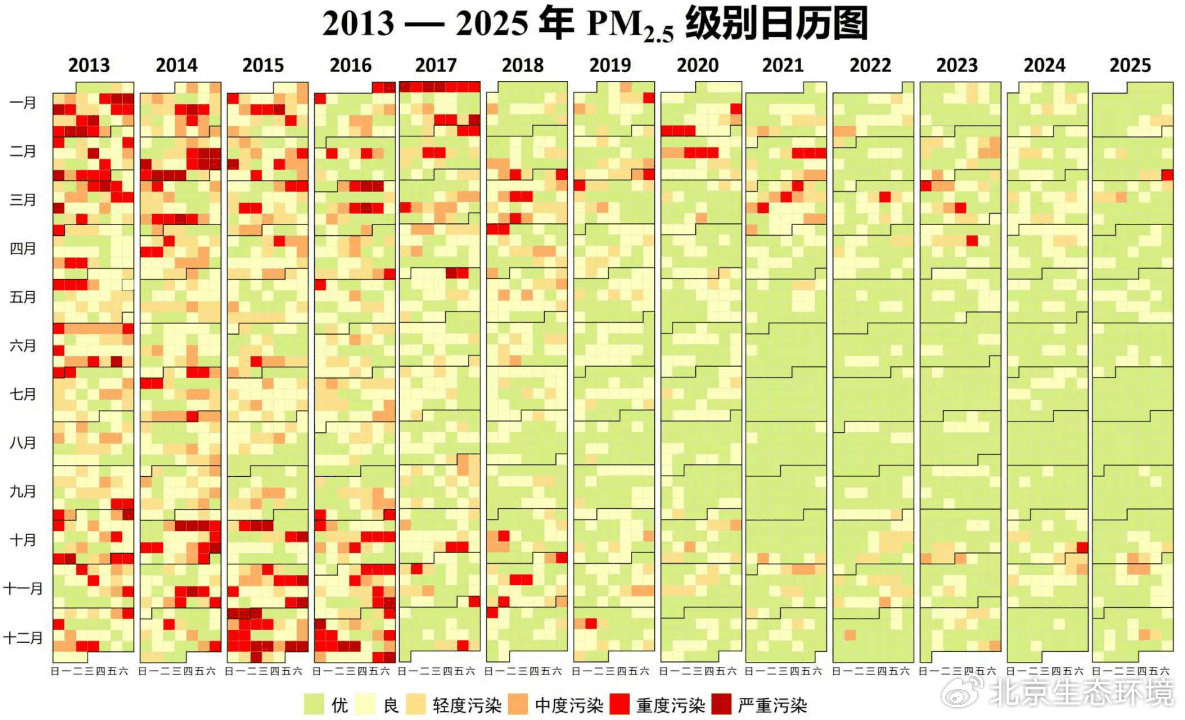
The full-year distributions are more informative than two selectively chosen weather photographs. This is not monitoring of DHH's itinerary.
The timeline matters. The 2019 report already documented substantial improvement since 2013. The pandemic separates his visits; it does not establish when pollution control began or what caused the subsequent improvement.
The environment ministry places its work across industrial, energy and transport changes, alongside controls on stationary and mobile pollution sources. The contribution of individual measures needs separate evaluation. Collectively, they describe work that requires sustained organization and investment. Ministry response
The result matters in ordinary life. People do not need to understand an industrial strategy before they can value a clearer sky or a better journey. That is part of how administrative achievement becomes a credible experience of progress.
It also complicates any story in which producing more excuses everything else. Cleaner air is an achievement worth demanding. Improvement has not removed pollution as a problem; WHO's health-based guidance remains more stringent. WHO guidelines
Development can continue while the way it happens changes. The question worth comparing is how a society turns that expectation into results.
Automation changes the explanation of industrial competition
DHH describes the production lines he saw as “almost entirely devoid of humans.” That is his observation of those lines, not a claim that an entire factory needs no people. Original account
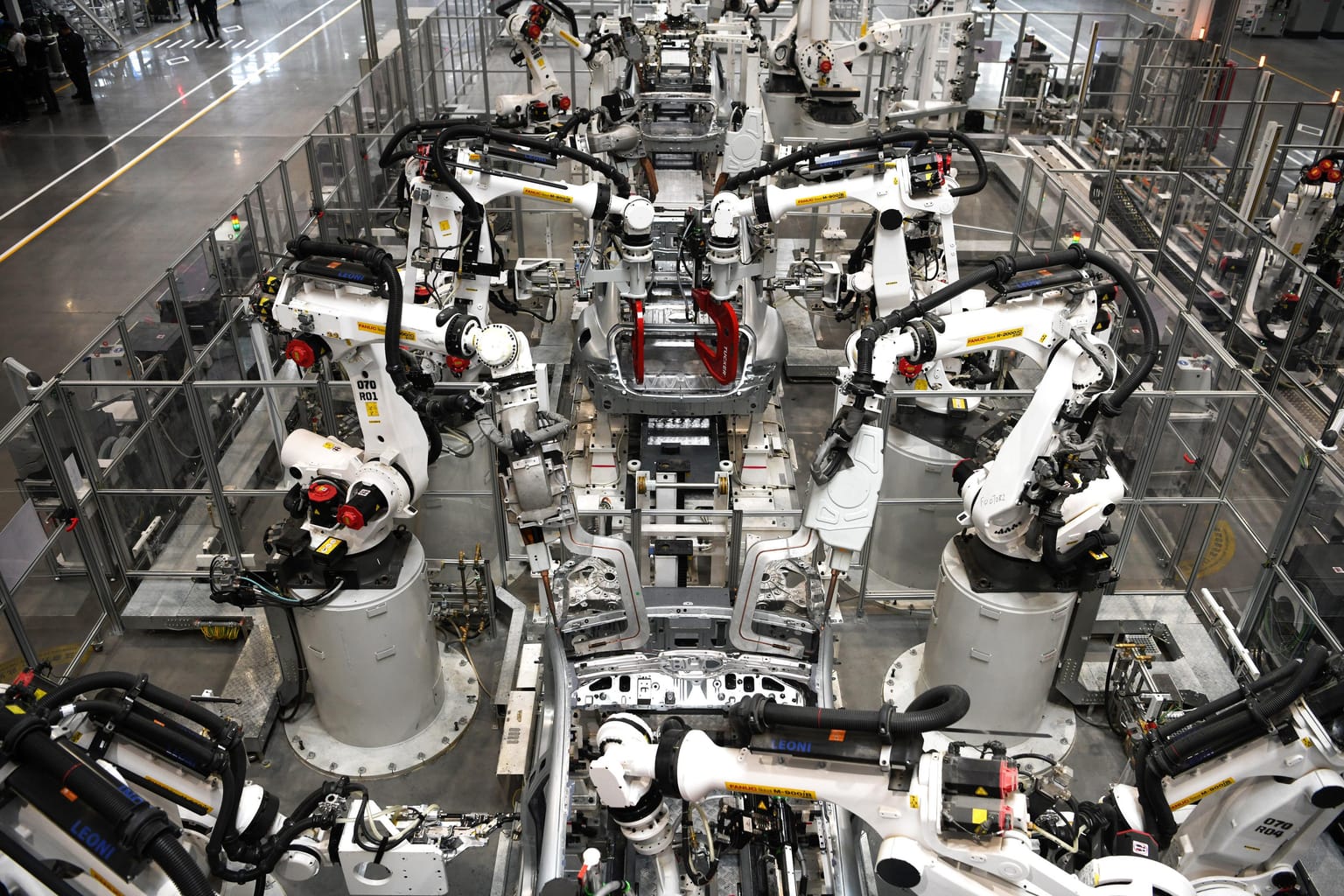
Beijing Daily factory report, March 29, 2024; reporters Sun Qiru and He Guanxin. Historical production imagery, not a photograph of DHH's visit.
Xiaomi's own factory description supplies a more precise scope: more than 700 robots and an overall automation rate of 91% in the body assembly workshop. Its separate statements about key processes cannot be generalized into a wholly unstaffed plant. Official factory description
The competitive question changes when equipment, software, inspection, logistics and engineering organization all contribute to a production system. Low wages alone become an inadequate explanation. Buying a robot and making many processes work reliably together are different achievements. Designing, integrating, maintaining and improving that system remain human work.
The photograph also contains FANUC markings. It is a useful reminder that industrial capability need not mean inventing every component domestically. Integration itself deserves study. A photograph, of course, cannot establish the national composition of a supply chain.
At industry level, the International Federation of Robotics reports that China accounted for 59% of new industrial robot installations in 2025. That is a year's installations, neither the entire installed stock nor an equivalent percentage of jobs displaced. IFR report
Competitors should examine their own production methods seriously. Residents are entitled to further questions: who gains skills and income, can suppliers earn a sustainable return, and do consumers receive dependable, affordable products? Those outcomes belong beside productive capability.
Valuing life in Canada includes wanting it to move forward
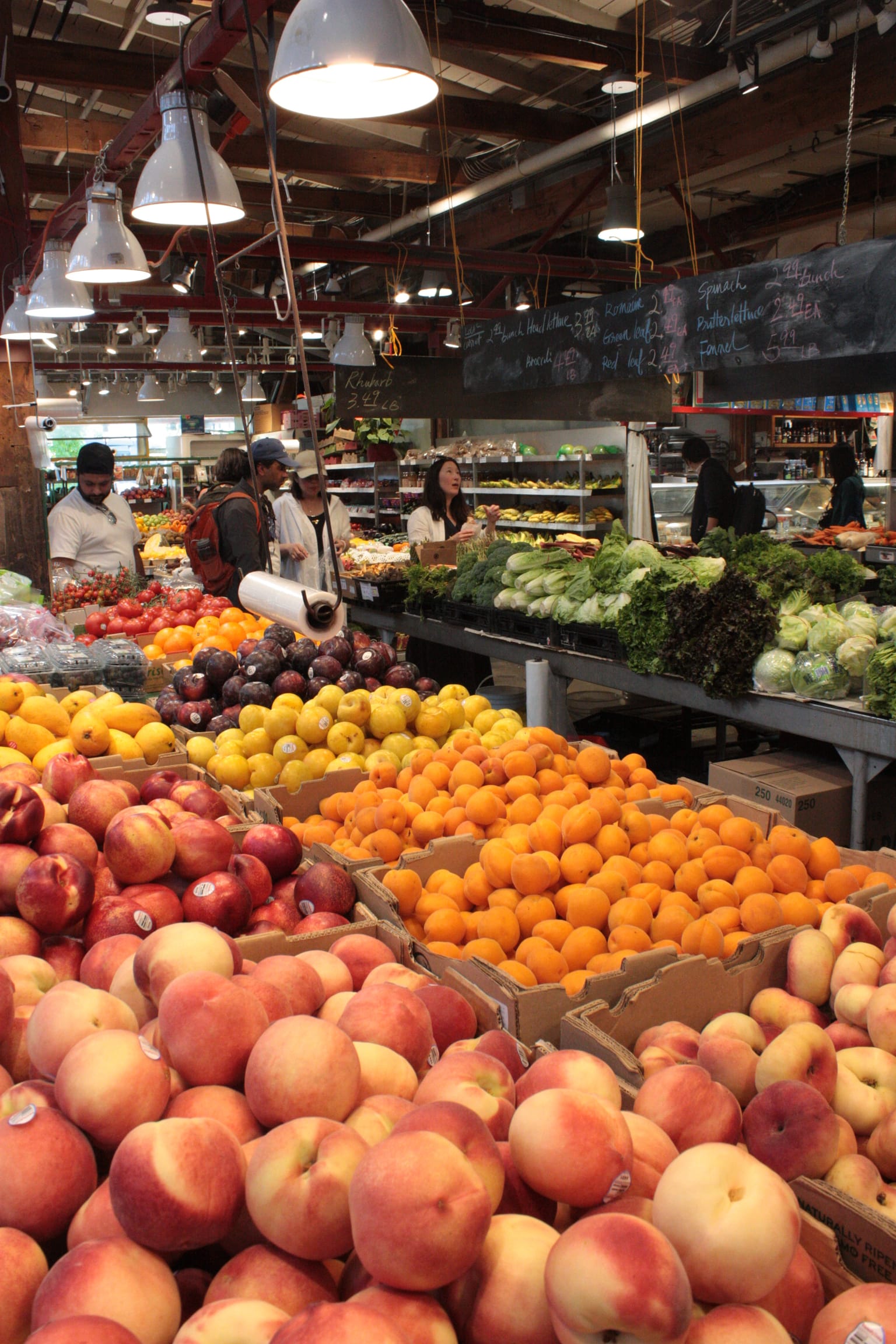
Everyday life in Vancouver: a July 2024 market photograph by Lbtexploring, CC0. It illustrates the personal reflection below; it is not evidence of comparative food safety.

I moved to Canada from China more than a decade ago. The rule of law, the environment and the reassurance I feel about everyday things, including food, are part of why I feel fortunate and content to live here. I do not want to lose sight of that gratitude when discussing Canada's problems.
Precisely because I value this life, I would like to see more dynamism, ambition to innovate and urgency about efficiency. Stability matters. People's hopes for the future also need new ideas and capabilities to sustain them.
Sometimes I think about a familiar picture of a good life: a home, a car, holidays, dependable rights and protections. Those are worth cherishing. If some of them, especially housing, become harder for younger people to obtain, calling a society mature is not much of an answer.
That does not establish that living standards have stood still for thirty or fifty years. A 2019 Statistics Canada study found that, at comparable ages, millennial households had higher incomes and assets than Generation X households, alongside more mortgage debt. Different measures can move in different directions. That historical study cannot describe everyone's circumstances today. Statistics Canada's generational study
I would put my concern more precisely: can the next generation still attain the security that people value, and can effort still bring a credible sense of progress? Those questions deserve more care than a blanket claim that nothing has improved.
There are concrete economic issues to examine. The OECD's 2025 survey of Canada identifies weak productivity growth, limited investment in assets important for innovation, weak business dynamics and limited competitive pressure. That is a diagnosis of economic constraints, not a description of every Canadian's attitude. OECD survey of Canada
I want both security and the capacity to keep improving. Innovation, competition and efficiency should help make a good life more dependable and accessible to more people.
Western values need a capacity to deliver
Past prestige provides little protection against a better current product. Engineering traditions and respected brands still have to earn their place through what customers can buy today. Dismissing a competitor as an illusion can also keep one's own weaknesses from being examined.
Europe has already diagnosed important constraints. The Commission's account of the Draghi report identifies slowing productivity, demographic pressure, energy costs and the investment needed for green and digital transitions. These are Europe's own questions about its future. Commission report portal
The difficult task is to build new capabilities while protecting what people value. Reliable services, fair opportunities and a healthy environment require investment over time. Treating every investment as a burden, or arguing only over the next distribution of cuts, can leave the future means of supporting those commitments unresolved.
I favor confronting competition directly. I do not think an efficient factory settles the merits of every environmental requirement, labor protection or opportunity for public participation. The air-quality example shows why: protecting living conditions can itself be progress. A rule should be assessed by whether it protects people and whether its implementation can improve.
Industrial support deserves a similar test. It should help an industry learn. If it becomes permanent exemption from competition, consumers and taxpayers should ask what future they are financing. Neither a slogan about openness nor one about protection answers that question.
A more durable Western confidence would come from improvements people can inspect: products worth buying, services they can rely on, and credible opportunities. Seeing problems addressed gives people a reason to participate in the next change.
The gains still have to reach people
DHH acknowledges intense working hours and the limits of a short visit. My view is that learning an industrial capability does not require accepting an entire social arrangement. Original account
A household can want a good, affordable car and time to enjoy it. A young person can welcome technical progress and still need a path to participate, develop and choose. If increasing pressure on people becomes the main proof of progress, greater output still owes them an answer about life.
That applies to China and the West. China can ask more of the productive capabilities it has developed: greater security and opportunity across people's lives. Western societies need industrial, technical and institutional renewal to keep their own social promises credible. Both demands can be held together.
Competition can force a society to learn again. It can expose obsolete assumptions and encourage better products and practices. Whether the benefits become broadly accessible depends on further choices by firms and public institutions, open to scrutiny.
The answer has to appear at home
DHH's closing attitude leaves room to act: he still believes the West can “make different choices.” Original account
I agree with his warning against complacency. The institutions and living conditions a society values still need new capabilities to sustain them. Where something works better, study how it works. Where it carries costs, count them too. I ask more of a mature society because I value the life it already makes possible and want that life to remain attainable.
For China, an impressive visit should remain a beginning rather than a final assessment. Continuing to improve the air residents breathe, creating opportunities to participate in technical progress, and making productive strength support a more hopeful life would give those achievements deeper meaning.
I hope China continues turning productive strength into better lives. I also hope Canada can preserve the rule of law and everyday security while renewing its capacity for innovation and efficiency. Both societies moving forward, with more people able to live securely and look ahead with hope, is the outcome I most want from this discussion.
Image and production credits
Cover and video preview: AI-assisted editorial portrait based on the GOSIM photograph of DHH speaking; framing and background were reworked. The original event photograph appears in the article. GOSIM organizer’s event photograph; Beijing municipal ecology source calendar; Beijing Daily factory photograph (Sun Qiru and He Guanxin,29 March2024), all identified at their relevant source links. Market photograph: Lbtexploring, Granville Island Public Market, July2024, CC0; framed/resized. These illustrate their stated contexts and do not document Aaron’s own visit. Film uses authorized synthesized narration and AI-assisted production.