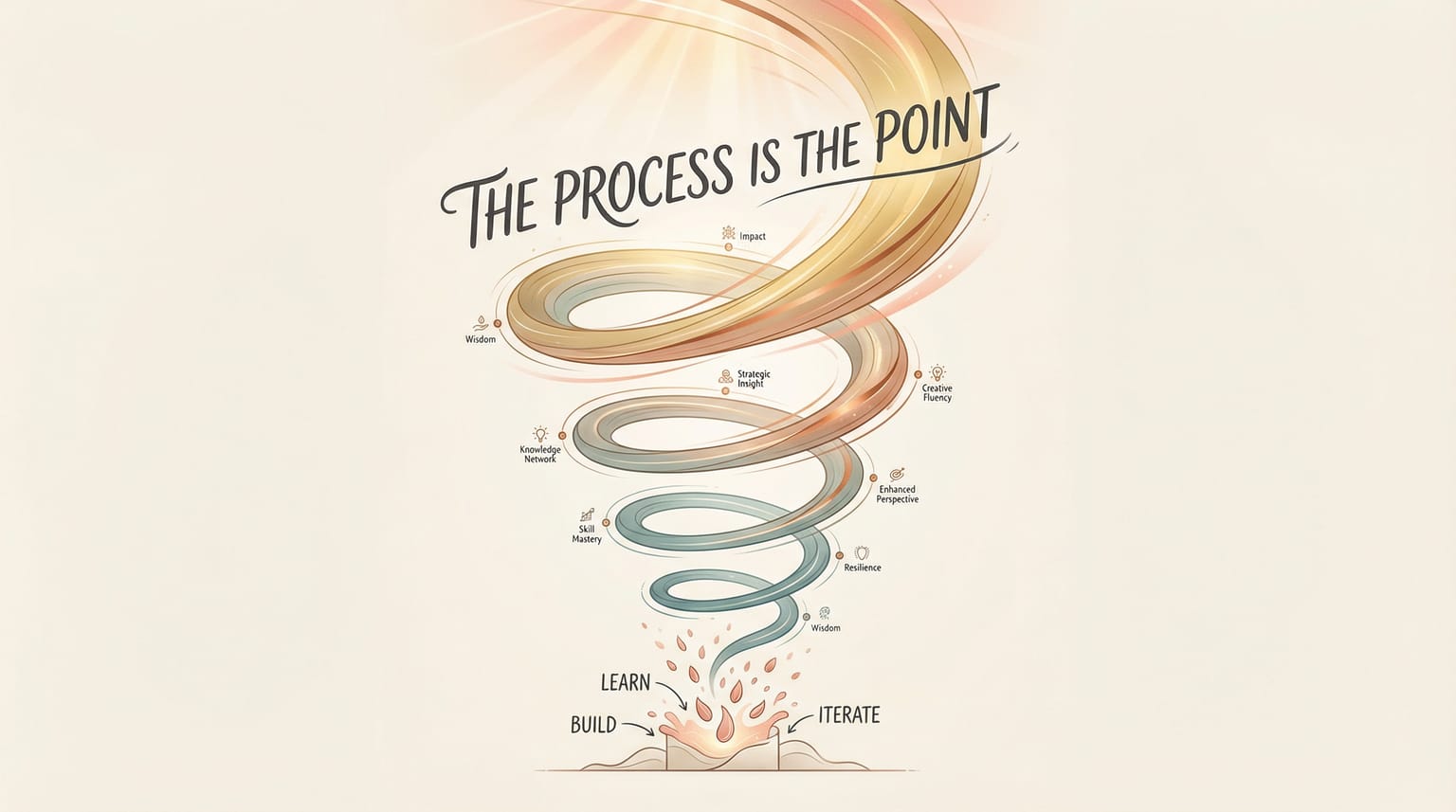
I Chased Goals for 15 Years. Chamath Showed Me What I Got Wrong.
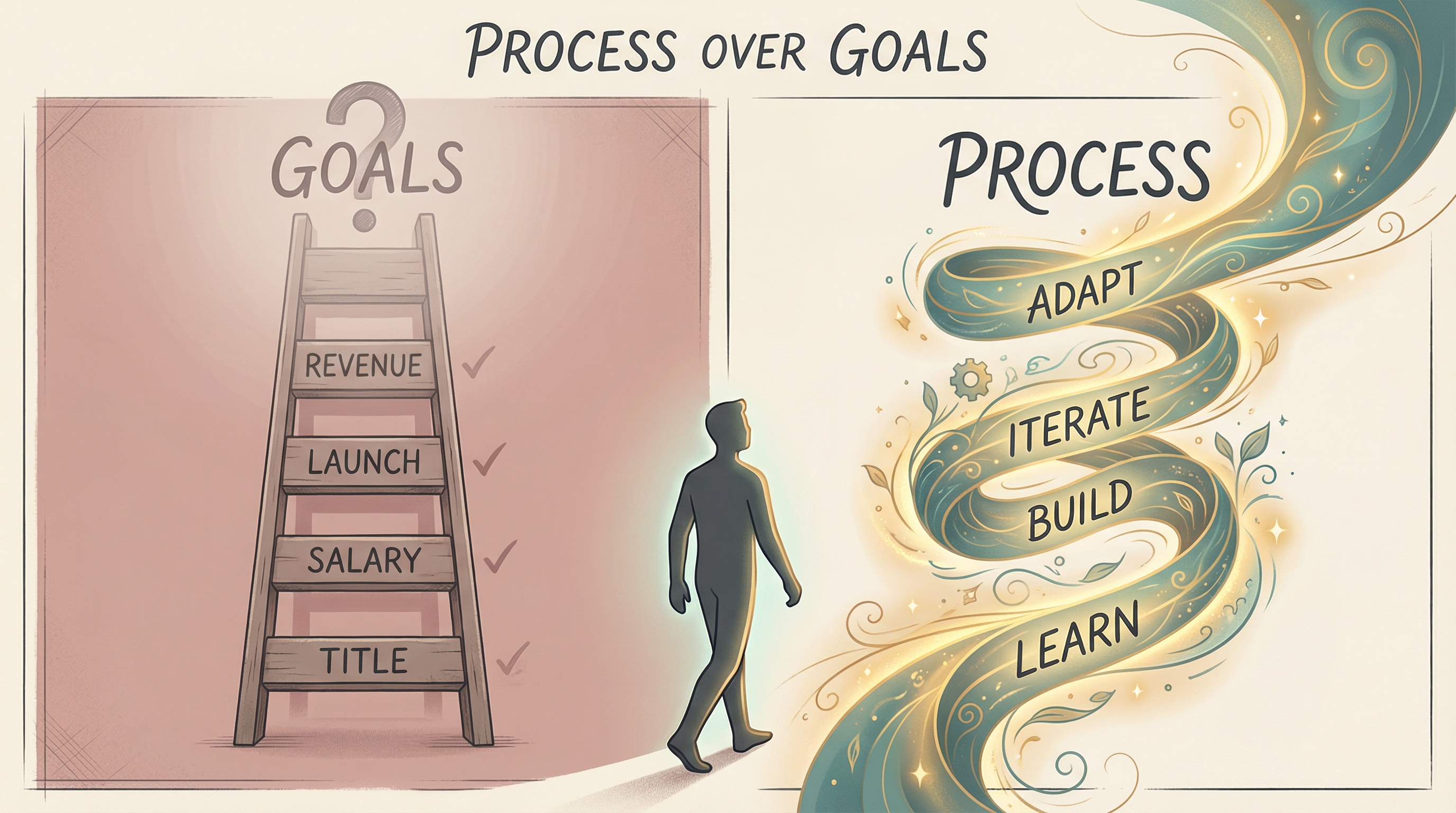
I've set goals my entire career. Become a Senior Manager by 30. Ship the product by Q3. Hit the revenue target by year-end. I checked every box. And then I watched Chamath Palihapitiya — the guy who built Facebook's growth engine and Social Capital — explain why goal-orientation is the wrong framework entirely.
His argument: the people who win aren't chasing endpoints. They're committed to a process of continuous learning that never stops. I've been testing this idea against my own career — and he's uncomfortably right.
The Goal Trap
For fifteen years, I optimized my career around milestones. Senior Manager by 30. Partner by 35. Ship the product. Hit the number. Each goal was clear, measurable, and motivating — exactly what every management book tells you to set.
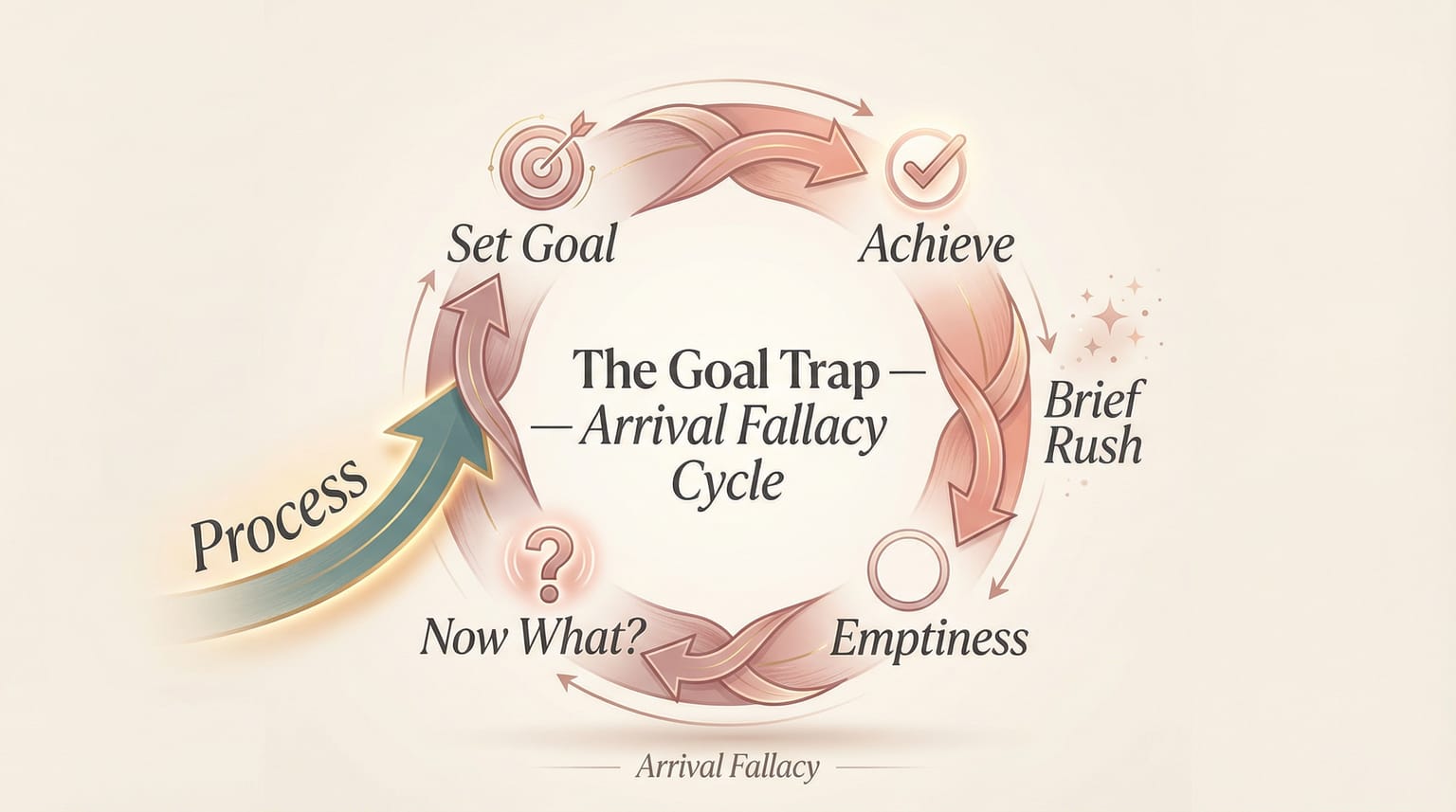
And I hit them. Most of them, anyway. But here's what nobody prepares you for: the moment after you arrive. There's a brief rush — a week, maybe two — and then a quiet emptiness. And the only response your brain offers is: now what?
So you set another goal. And another. Goal → achieve → emptiness → new goal → repeat.
Psychologist Tal Ben-Shahar calls this the "arrival fallacy" — the illusion that reaching a destination will bring lasting happiness. He discovered it through his own experience as an elite squash player: every victory brought a brief euphoria that faded almost immediately. The destination was never the point. But he didn't realize that until he'd spent years chasing it.
I didn't either.
Then I watched Chamath's video — "30 Years of Business Advice" — and something clicked.
Chamath Palihapitiya — 30 Years of Business Advice in 39 Minutes
His first rule is "Never Stop." But he's not talking about hustle culture. He's talking about committing to the process of learning and risk-taking, not to endpoints. Warren Buffett at 95 isn't chasing a goal. He's running a process. Charlie Munger was the same way. The people who sustain excellence across decades aren't the ones with the best goals. They're the ones who never stopped learning.
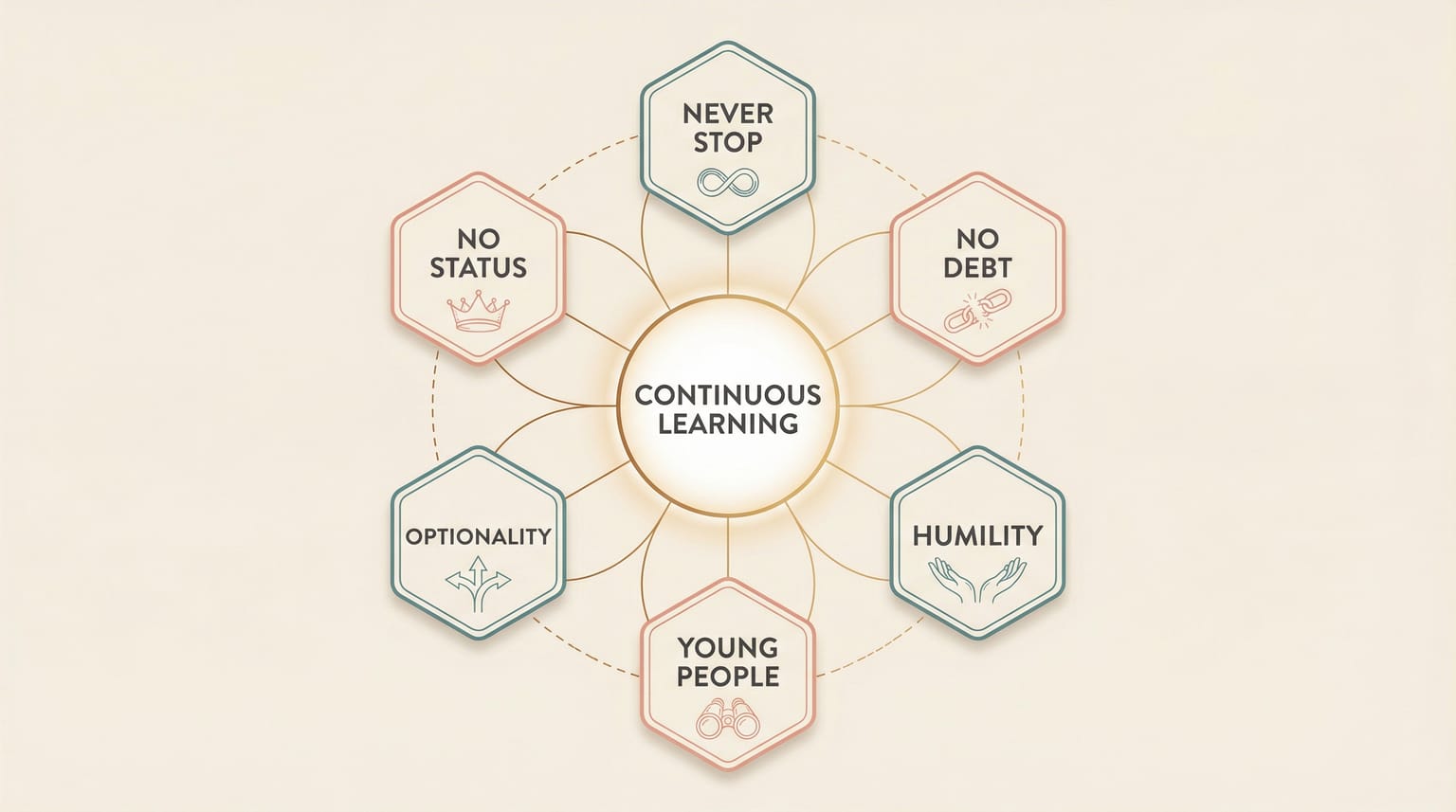
Chamath compressed 30 years into 6 rules. When you look at them through the lens of "process over goals," they stop being a list of tips and start functioning as a coherent operating system.
The 6 Rules as a System
Here's what most summaries of Chamath's video miss: these aren't 6 independent tips. They're interconnected principles that all protect the same thing — your ability to keep learning. Remove any one of them, and the system breaks.
Rule 1: Never Stop. This is the foundation. Don't treat life as a series of objectives where you declare victory and stop. Commit to continuous learning and continuous risk-taking. Not "work 80 hours a week" — rather, never allow yourself to stop growing. The most stagnant years of my career were when I was "executing against a plan" instead of learning. I had a roadmap, a timeline, clear deliverables — and I was coasting intellectually. The most productive period? The last six months. No plan. Just learning AI by building with it every day.
Rule 2: No Debt. Debt — financial and technical — forces you into goal-orientation. When you owe, you optimize for short-term payoff, not long-term learning. Debt constrains optionality. Chamath points out how social media's curated lifestyles push young people toward material consumption → debt → being trapped in jobs they hate just to service payments. I see the same pattern in product work. When your codebase is buried in technical debt, every sprint becomes about patching, not learning. Same principle at the personal level: financial freedom isn't about luxury. It's about preserving the freedom to learn.
Rule 3: Manage with Humility. Be absolutely honest about where you are right now. Not where you wish you were. Not where your goals say you should be. Honest assessment of current state. The hardest part of my AI transition was admitting I was starting from zero. Not "I have 15 years of experience, I'll figure it out fast." The honest assessment: I'm a beginner at AI-native building. I don't know what I don't know. That humility was uncomfortable — but it unlocked faster learning than any confidence could have.
Rule 4: Surround Yourself with Younger People. Chamath says your cognition solidifies at some point. Young people are "early warning systems for the future" — they help you see your blind spots. This isn't mentorship, which is a goal-oriented frame ("I'll teach them"). It's staying connected to emerging patterns, which is a process. The junior developers on my team adopted AI tools faster than anyone. They didn't have 15 years of "the way things are done" to unlearn. They were my signal that the shift was real — and that I needed to move.
Rule 5: Preserve Optionality. Pursue win-win in business, negotiation, and life. Don't lock into paths that close doors. This is fundamentally anti-goal: goals narrow your focus to one outcome, while optionality keeps it wide. I've been building side projects while keeping my day job. Not "I'm quitting to go all-in" — that's goal-oriented thinking. Instead: "I'm building capability and keeping doors open." Process-oriented thinking protects relationships, preserves options, and reduces the self-destructive moves that come from being locked into a single path.
Rule 6: Status is Manufactured. All external recognition — the lists, the clubs, the invitations — are hooks that give others judgment over you. Chasing status is the ultimate goal-orientation trap. It optimizes for other people's scorecards, not your own learning. Chamath calls disengaging from the status game a superpower. I've experienced this firsthand: titles and promotions felt great for a week. The actual skill-building — learning to code AI agents, publishing daily, building a content studio from scratch — has compounded in ways no title ever did. Nobody gave me a certificate for it. And that's exactly the point.
Why This Matters More Now Than Ever
You could argue that "process over goals" has always been good advice. And you'd be right — Kahneman, Seligman, and a century of psychology research back it up. But there's a reason this framework is especially critical right now.
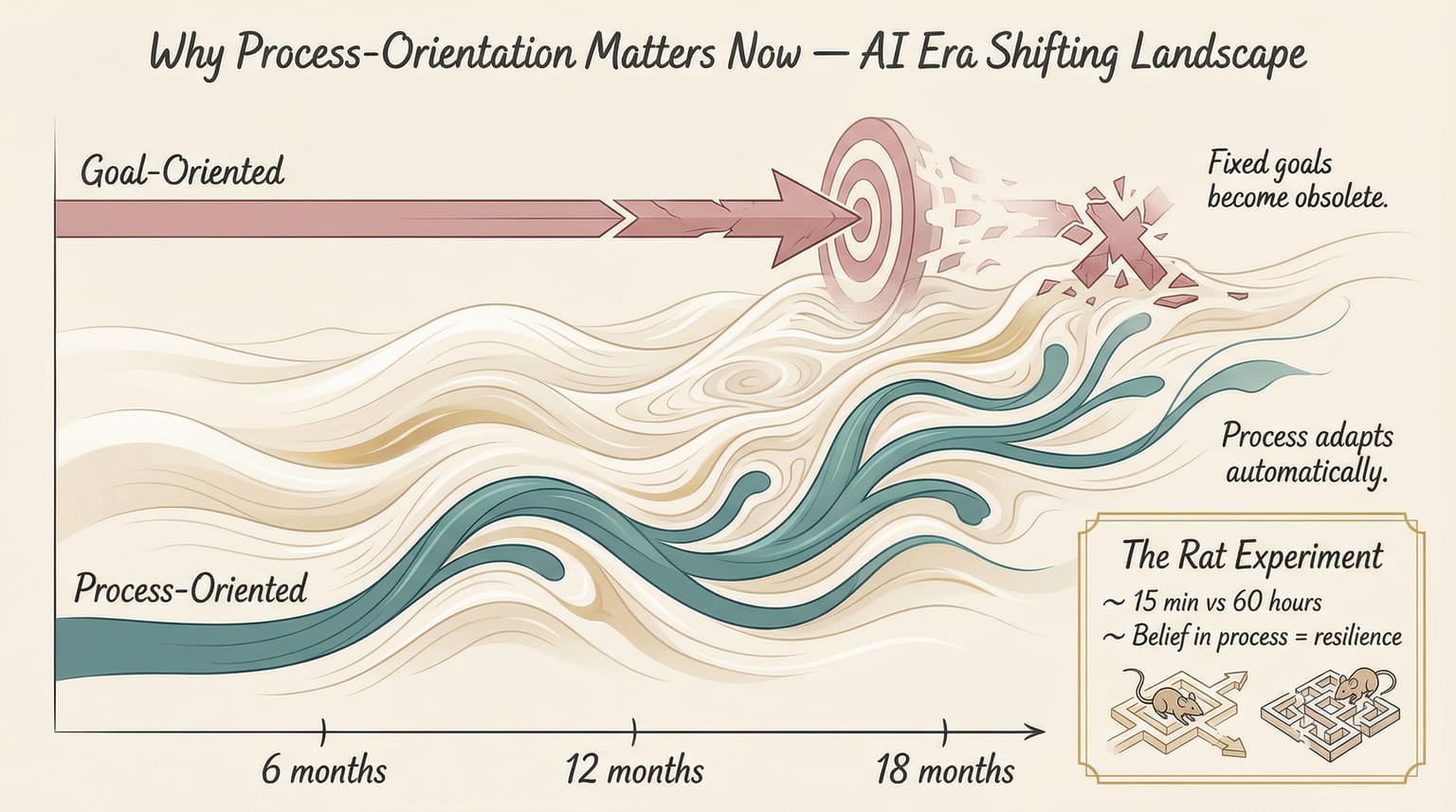
AI is accelerating the rate at which the landscape shifts. When the ground moves every six months, goals based on today's assumptions become obsolete before you reach them. The person who set a goal to "master prompt engineering" in January 2025 watched AI agents make that skill dramatically less relevant by December 2025. The person who committed to "learning how AI systems work" adapted seamlessly — because their north star was the process, not the destination.
Process-oriented people adapt automatically. They don't need to tear up their plan and start over every time the technology shifts. They were never attached to a specific plan in the first place.
Chamath references a 1957 experiment by Curt Richter that makes this visceral. Richter placed wild rats in water jars to measure how long they could swim before drowning. Most gave up within 15 minutes. But when he rescued them briefly — pulled them out, let them rest, then put them back — the rats that had been saved once swam for up to 60 hours. Not 60 minutes. 60 hours.
The difference wasn't physical strength. It was belief. The rats that had been rescued believed the situation wasn't hopeless. They had evidence that persistence could lead to being saved.
For builders navigating AI's uncertainty, the equivalent isn't believing a specific outcome will happen. It's believing in your own process — that if you keep learning, keep building, keep adapting, you'll find your way. That belief is what sustains you when everything else is shifting.
Chamath's practical advice for young people reinforces this: "Go to the main stage." If you're in tech, go to Silicon Valley. If you're in finance, go to New York. This sounds like a goal — move to a specific city — but it's actually process-thinking. You're optimizing for learning environment and opportunity density, not for a specific reward.
His most controversial point: "Work-life balance is a false issue." Before you dismiss this as billionaire hustle culture, listen to the reframe. When you find flow in a process you love, the balance question dissolves. Not because you work 24/7, but because the work doesn't feel like a sacrifice. I experience this with AI building. I work on it at 11pm sometimes — not because I have to, but because I'm in flow. That's not imbalance. That's alignment.
The Anti-Goal Operating System
After absorbing Chamath's framework, I looked at how I'd been operating during my AI transition — the period where I've been most productive and most fulfilled — and realized I'd already been following a version of this system. I just hadn't articulated it.
Here's what it looks like in practice:
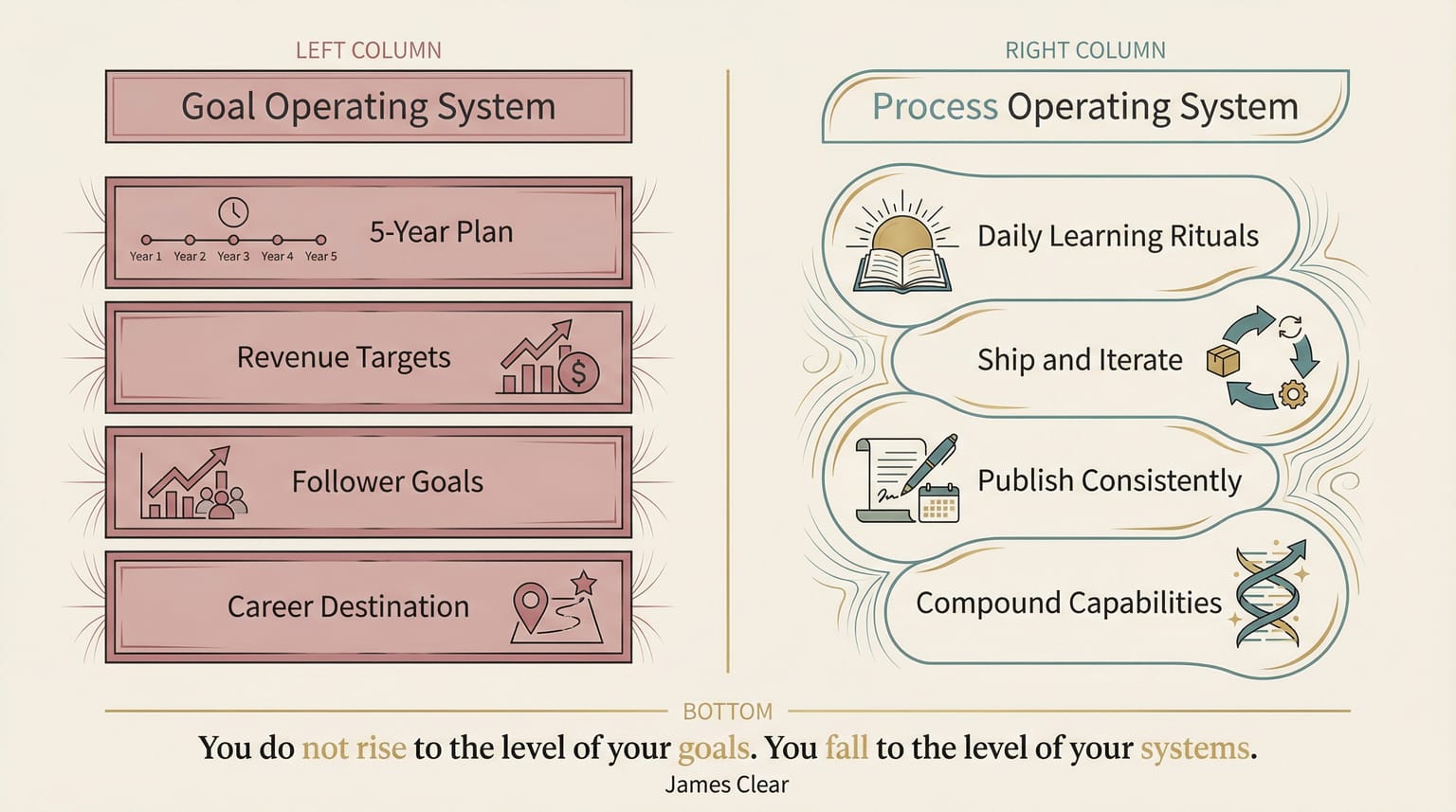
No 5-year plan. Instead: daily learning rituals. Build something with AI every day. Some days it's a new workflow. Some days it's a blog post. Some days it's a failed experiment that teaches me something I couldn't have learned any other way.
No revenue targets for side projects. Instead: ship and iterate. Let the market teach me. The feedback from publishing and building is more valuable than any forecast I could write in a spreadsheet.
No follower goals for the newsletter. Instead: publish consistently, and make each piece better than the last. The growth has been a byproduct of the process, not the target.
No career destination. Instead: accumulate capabilities that compound. Every skill I build feeds into the next one. Writing improves my thinking. Building AI workflows teaches me what's possible. Publishing teaches me what resonates.
The paradox is real: process-orientation often achieves "goals" faster than goal-orientation does. When you stop wasting energy on the anxiety gap — the distance between where you are and where your goal says you should be — you redirect that energy toward actual work. James Clear articulated this perfectly: "You do not rise to the level of your goals. You fall to the level of your systems." Chamath is saying the same thing from a different angle.
The compounding effect is the key. When your north star is "learn continuously," every day's output — even the failures — feeds into tomorrow's capability. When your north star is "hit X by date Y," the days that don't advance the metric feel wasted. One framework compounds. The other creates anxiety.
The Process Is the Point
Chamath's 6 rules aren't 6 separate lessons. They're one lesson with six facets: commit to the process of learning, remove the things that stop you — debt, status-seeking, fixed goals, ego — and stay relentlessly honest about where you actually are.
The best career advice I've received in recent memory isn't "set bigger goals" or "hustle harder." It's this: the people who win are the ones who never stop learning. Not because they have a target. Because the process itself is the point.
My AI transition is living proof. No business plan. No timeline. No revenue target. Just a commitment to building with AI every single day. And somehow, it's producing more results than any goal-oriented plan I've ever written.
I'm documenting this process — building with AI, learning in public, shipping weekly. Follow along if that resonates.